Calcutta High Court Delivers Landmark Ruling on Consent and False Promises
The Calcutta High Court has issued a significant judgment clarifying that consent obtained under misconceptions does not constitute valid legal consent. This ruling came on Wednesday as the court upheld rape charges in a protracted 12-year-old case, reinforcing the legal principle that deception invalidates consent.
Case Background: A Promise of Marriage in Exchange for a Child
The case centers on a married man who entered into a relationship with a 20-year-old woman, promising to marry her if she bore him a child. According to court documents, the woman, described as illiterate and from a rustic village background, was 19 or 20 years old at the time. The man's assurance of marriage was conditional upon her giving him a child, which she eventually did.
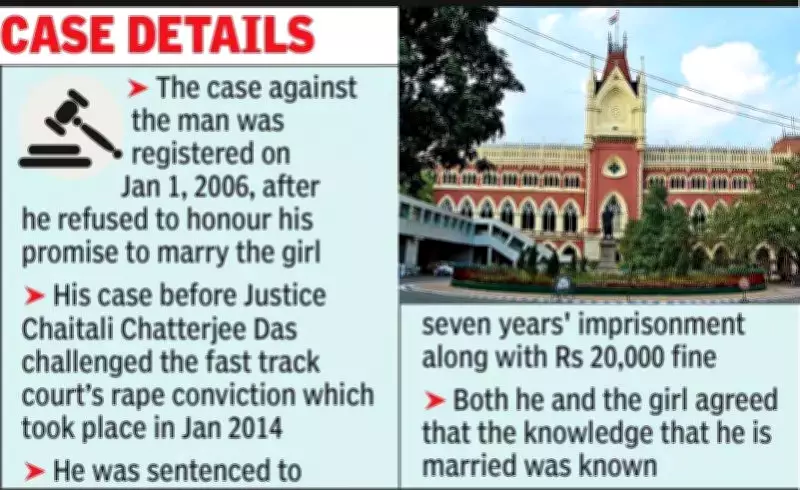
The legal proceedings began on January 1, 2006, after the man refused to honor his promise of marriage. The case saw multiple stages of litigation, culminating in a conviction by a fast track court in January 2014. The convicted man was sentenced to seven years of rigorous imprisonment and fined Rs 20,000.
Justice Chaitali Chatterjee Das's Pivotal Observations
Justice Chaitali Chatterjee Das, presiding over the appeal, delivered a detailed judgment that addressed the core issue of consent. While testimonies from the survivor's brother and sister-in-law indicated a consensual relationship, Justice Das emphasized the critical role of the man's false promise.
"It is clear that the survivor had sexual intercourse with the accused on the representation made by the accused that he would marry her," Justice Das stated. "This was a false promise held out by the accused, and had this promise not been given, perhaps she would not have permitted the accused to have sexual intercourse. Therefore, whether this amounts to consent or the accused obtained consent by playing fraud on her... This kind of consent obtained by the accused cannot be said to be any consent because the survivor from the very beginning was under a misconception of fact that the accused intends to marry her, therefore, she had submitted to sexual intercourse with him."
Legal Arguments and Counterarguments
The convict's defense rested primarily on the claim that the survivor had engaged in a consensual sexual relationship while fully aware of his marital status. However, the survivor's counsel refuted this argument, pointing out that the man, being Muslim, is permitted under personal law to have a second marriage. Therefore, his existing marriage did not necessarily negate the possibility of a future union, making the promise plausible to the survivor.
Justice Das supported this view, noting, "It is a clear case of deception from the beginning as the man, being a married person, only in order to satisfy his lust assured her, who was a 19/20-year-old illiterate and rustic village girl..."
Survivor's Narrative and Societal Pressures
The survivor's counsel elaborated on the emotional and societal dimensions of the case. At age 20, the woman fell in love with the man and agreed to sexual relations based on his promise of marriage contingent upon her bearing a child. When she became pregnant, he reneged on his promise.
Fearing societal stigma and consequences, the survivor concealed her pregnancy until an advanced stage before revealing it to her parents. After the child's birth, her parents approached the man, urging him to marry her, but he refused. This refusal led to the filing of a formal complaint at the Burwan police station in Murshidabad district.
Accused's Version and Allegations of Extortion
In his defense, the man presented an alternative narrative. He claimed that after the child was born, the survivor's family approached him with compromise talks, demanding a substantial sum of money. According to his version, when he refused to pay the demanded amount, the family lodged a police complaint against him, framing the case as one of rape and deception.
Despite this contention, the court found the evidence of false promise and misconception compelling enough to uphold the conviction, emphasizing that consent vitiated by fraud does not hold legal validity.
Broader Implications of the Judgment
This ruling by the Calcutta High Court sets a significant precedent in cases involving consent obtained through deceit. It underscores that consent must be informed and free from misconception to be legally valid. The judgment highlights the judiciary's role in protecting vulnerable individuals from exploitation under the guise of false assurances.
The case also touches on intersections of personal law, societal norms, and criminal justice, offering a nuanced perspective on how promises of marriage can be weaponized to obtain consent under fraudulent circumstances.