Religious Event at Bhopal Gas Victims' Hospital Triggers Controversy Over Noise Rules
The organization of a 'Virat Hindu Sammelan' by a right-wing group within the premises of the Bhopal Memorial Hospital & Research Centre (BMHRC) has ignited significant controversy and drawn sharp criticism from non-governmental organizations dedicated to supporting survivors of the devastating Bhopal gas tragedy. This specialized hospital was established under the directive of the Supreme Court specifically to provide free medical treatment to the victims of the 1984 Bhopal gas disaster, making the event particularly contentious.
NGOs Raise Alarm Over Legal Violations and Patient Welfare
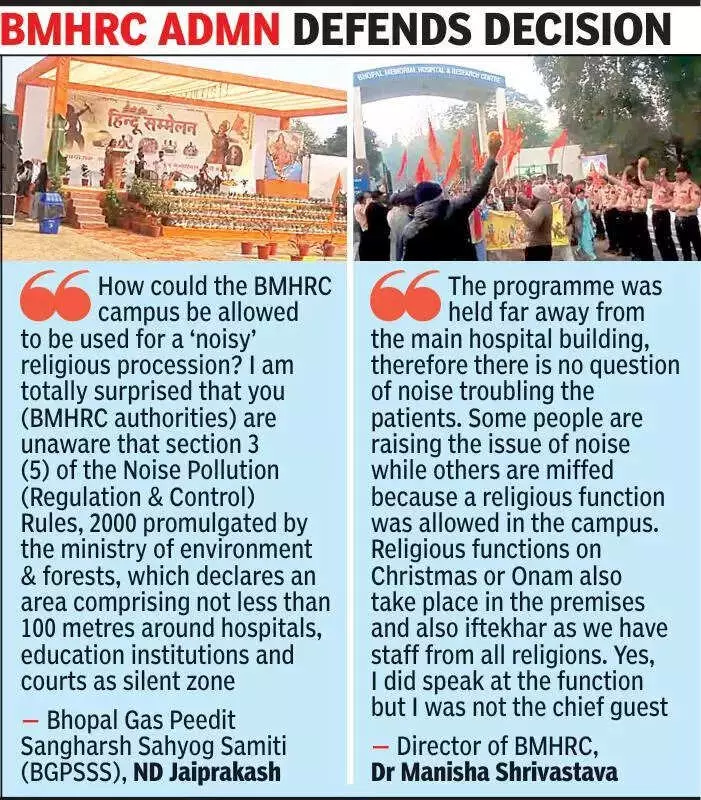
Non-governmental organizations working closely with the gas tragedy survivors have expressed profound concern and outrage over the incident. The event featured a DJ and participants raising slogans while carrying saffron flags, activities that directly contravene the established silent zone regulations mandated for hospital premises. ND Jaiprakash, the convener of the Bhopal Gas Peedit Sangharsh Sahyog Samiti (BGPSSS), took immediate action upon discovering photographs and videos showing hundreds of attendees entering the BMHRC campus for the Sammelan.
In a formal letter addressed to the hospital's acting director, Dr. Manisha Shrivastava, Jaiprakash questioned how such a "noisy religious congregation" could be permitted within a hospital area that is legally designated as a silent zone. He explicitly referenced Section 3(5) of the Noise Pollution (Regulation & Control) Rules, 2000, which clearly stipulates that a radius of at least 100 meters around hospitals, educational institutions, and courts must be maintained as a silent zone. Copies of this complaint letter were also forwarded to the Indian Council of Medical Research (ICMR), the governing body responsible for administering the hospital, and brought to the attention of the Supreme Court-appointed Monitoring Committee overseeing the facility's operations.

Broader Concerns About Hospital Management and Priorities
The controversy has escalated beyond the immediate noise violation issue, prompting serious questions about the hospital's management and its core mission. Rachna Dhingra, co-convener of the Bhopal Group for Information & Action (BGIA), voiced strong criticism, stating to media sources that "BMHRC has seemingly transformed into an event management agency rather than a dedicated healthcare institution." She emphasized that if the ICMR is genuinely committed to effectively running BMHRC, it must conduct a thorough and serious evaluation of the current dismal state of patient care and address concerns that critical funds might be diverted towards management's personal objectives rather than patient welfare.
Purnendu Shukla, a member of the Supreme Court Monitoring Committee, underscored the gravity of the situation, noting that the issues raised are "extremely important." He expressed surprise that a religious procession was allowed on hospital grounds and raised the critical question of who authorized the event's entry into the premises. Shukla highlighted the potential distress such activities could cause to patients, stating, "If such activities take place in a hospital campus, you can understand what the patients will be facing."
Hospital Administration's Defense and Justification
In response to the mounting criticism, Dr. Manisha Shrivastava, the acting director of BMHRC, offered a defense of the event's organization. When questioned about the incident, she countered, "Can you expect me to breach the discipline and decorum of the hospital?" She clarified that the program was conducted at a location far removed from the main hospital building, thereby asserting that there was no possibility of noise disturbing the patients. Dr. Shrivastava suggested that the objections stemmed partly from the religious nature of the function, noting that similar religious events, such as Christmas or Onam celebrations, are also held on the premises to accommodate the diverse religious backgrounds of the hospital staff.

She further pointed out that the event took place on a Sunday, which is a non-OPD day, minimizing patient presence and disruption. Dr. Shrivastava emphasized that the Sammelan was not exclusively a religious gathering but included other events as well. When specifically asked if she had participated as the chief guest and addressed the assembly, she confirmed that she did speak at the function but clarified that she was not the chief guest, seeking to downplay her direct involvement in the controversial event.
This incident has sparked a broader debate about the appropriate use of hospital campuses, adherence to environmental and noise pollution regulations, and the primary focus of institutions dedicated to serving vulnerable populations like the Bhopal gas tragedy survivors.