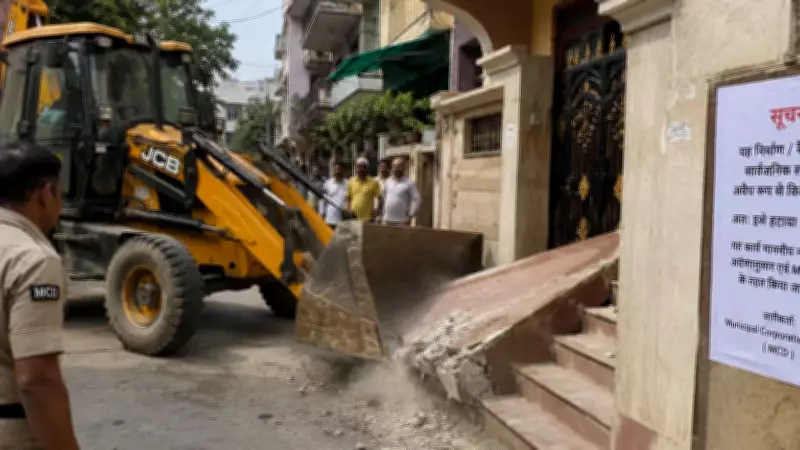
Public roads and footpaths are designed for unrestricted public use, but conflicts often emerge when structures such as ramps, staircases, extensions, kiosks, or temporary installations encroach upon these spaces. To address such violations, civic authorities across India regularly conduct anti-encroachment drives, removing unauthorized structures occupying public land. Understanding the laws and regulations governing these drives is essential, as they vary based on the type of road.
National Highways
Under the Control of National Highways Act, 2002, no person may occupy any highway land or discharge material through a drain on such land without prior written permission from the highway administration or an authorized officer. However, such permission is valid for no more than one month from the date of grant unless renewed. According to Section 26 of the Act, for any unauthorized occupation on highway land, a notice is issued requiring the occupant to restore the land to its original condition within a specified period. If the occupation is not removed within that time, it will be cleared at the expense of the central or state government, which may impose a penalty of Rs 500 per square meter of illegally occupied land, with the amount potentially increasing based on land cost. The highway administration can also act without notice if the unauthorized occupation involves a temporary shop (such as a stall or kiosk), a construction, or other easily removable structures that do not require machinery. Police assistance may be sought if necessary to remove such occupations using reasonable force.
State and City-Specific Roads
States and cities have their own regulations regarding encroachments. According to Section 226 of the UP Revenue Code 2006, any encroachment or obstruction on a public road (including a chak road), path, or common village land invites a penalty between Rs 500 and Rs 10,000. Additionally, the Sub-Divisional Officer or Tahsildar may require the offender to execute a personal bond of up to Rs 15,000 to ensure they refrain from repeating the illegal occupation. In Delhi, the authority responsible for removing encroachments depends on road width: the Municipal Corporation of Delhi (North/South/East) handles roads less than 60 feet wide, while the Public Works Department (PWD) manages roads 60 feet or wider. The New Delhi Municipal Council (NDMC) oversees central areas like Connaught Place and Janpath, and the Delhi Development Authority (DDA) handles Urban Extension Roads. In the case of Puran Chand vs Delhi Fire Service (2023), the Delhi High Court directed the MCD to impose an on-the-spot fine of Rs 10,000 for illegal eateries and food stalls encroaching on public roads.

Supreme Court Guidelines
In response to growing instances of 'Bulldozer Justice,' the Supreme Court of India, in Writ Petition (Civil) No. 295 of 2022, issued a nationwide judgment requiring that the concerned authority can take steps to demolish an illegal structure only after 15 days of issuing a notice. The demolition process must be videographed to ensure transparency and accountability.
These laws aim to balance the need for public space with the rights of individuals, ensuring that encroachments are dealt with fairly and systematically.