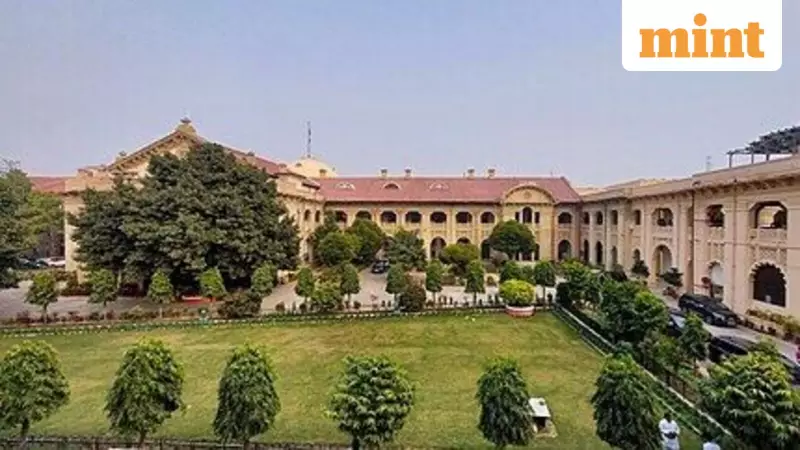
Allahabad High Court Sets Legal Precedent on Maintenance Eligibility
The Allahabad High Court has delivered a landmark judgment stating that a wife becomes ineligible for financial maintenance if her own conduct or the actions of her relatives directly result in her husband's inability to generate income. This ruling establishes a significant legal precedent concerning the complex intersection between domestic behavior and financial responsibilities within marriage.
Case Background and Court Decision
The court arrived at this conclusion while dismissing a revision petition filed by a woman seeking financial support from her husband, who practices homeopathy. The husband's earning capacity was severely impaired after he was allegedly shot by his father-in-law and brother-in-law during a violent altercation at his private clinic.
Justice Lakshmi Kant Shukla, who presided over the case, upheld a previous ruling by a Kushinagar family court. He emphasized that awarding maintenance under these specific circumstances would represent a serious miscarriage of justice, particularly when a man's professional livelihood has been destroyed by the criminal actions of the claimant's immediate family members.

Court Observations and Legal Reasoning
"While Indian society generally expects a husband to work and maintain his family, this case presented unique circumstances," the court of Justice Shukla noted. "It is well settled that though it is the pious obligation of a husband to maintain his wife, no such explicit legal duty has been cast upon the wife by any court of law."
Evidence presented during proceedings revealed that Ved Prakash Singh sustained life-altering injuries during the assault, leaving him physically incapacitated. The High Court highlighted that a pellet remains embedded in his spinal cord, with surgical removal posing a severe risk of permanent paralysis. Consequently, he cannot sit for extended periods or maintain steady employment.
"If a wife by her own acts or omissions causes or contributes to the incapacity of her husband to earn, she cannot be permitted to take advantage of such a situation and claim maintenance," the court stated unequivocally. "Granting maintenance in such circumstances would result in grave injustice to the husband, and the court cannot shut its eyes from the reality emerging from the record," it added.
Lower Court Proceedings and Final Assessment
On May 7, 2025, the lower court had already denied the wife's request for interim support. In its comprehensive final assessment, the High Court stressed that the husband's disability was an undisputed fact resulting directly from the actions of the wife's relatives, thereby disqualifying her from claiming financial support.
Contrasting Ruling on Qualifications and Maintenance
In a separate but related development, the Allahabad High Court recently ruled in another case that a wife cannot be denied maintenance under Section 125 of the Criminal Procedure Code (CrPC) merely because she possesses high qualifications or vocational skills.
Setting aside a family court order that had rejected a woman's application for maintenance from her husband, Justice Garima Prashad observed that it is "misplaced for a husband to rely solely on the qualifications of his wife to evade his legal obligation to maintain her."
The court clarified that a wife's mere potential to earn income is fundamentally distinct from actual gainful employment, reinforcing that qualifications alone cannot justify denying maintenance rights.