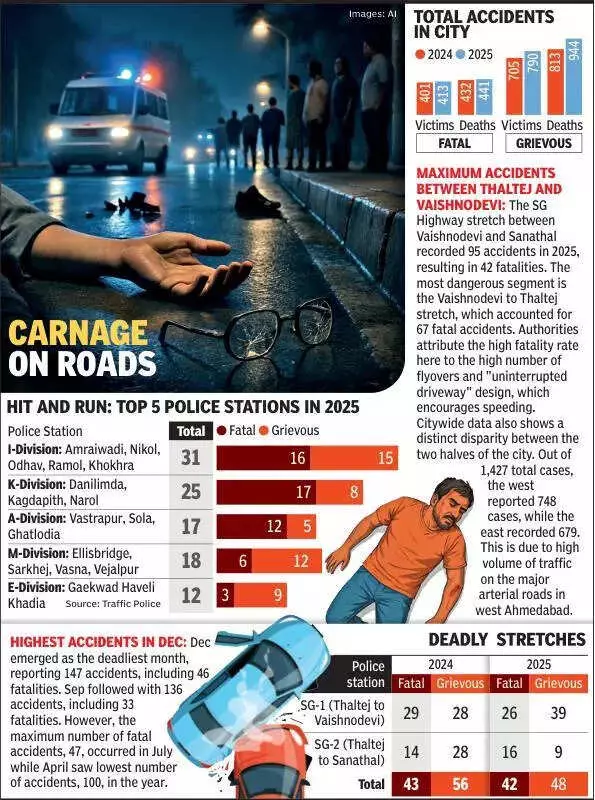
New traffic police data from Ahmedabad paints a grim picture for road safety in 2025, revealing a shocking surge in deadly hit-and-run incidents that far outpaces the growth in overall fatal accidents. The figures point to a deepening crisis on city roads, driven by reckless driver behaviour, enforcement challenges, and increasing traffic pressure.
Alarming Numbers: Hit-and-Runs Outpace Overall Accident Growth
The official statistics show that while fatal accidents in Ahmedabad increased by nearly 7.7%—from 401 in 2024 to 432 in 2025—the situation is far more severe for hit-and-run cases. Fatal hit-and-run incidents jumped by a staggering 49%, rising from 59 deaths in 2024 to 85 in 2025. Incidents causing major injuries also saw a sharp rise of 27%, with 75 cases recorded last year compared to 59 the previous year.
In total, the 432 fatal accidents claimed 441 lives in 2025. The city also recorded 813 accidents resulting in major injuries and 182 leading to minor injuries. The number of people suffering grievous injuries rose by 15%, from 790 in 2024 to 944 in 2025. Overall, Ahmedabad witnessed 1,427 accidents involving fatalities, grievous injuries, and minor injuries last year, up from 1,323 in 2024.

Geographic Hotspots and Driver Behaviour Under Scrutiny
The data identifies specific police divisions as major hotspots. K-Division, covering Danilimda, Kagdapith, and Narol, topped the list with 17 fatal hit-and-run cases. It was closely followed by I-Division—encompassing Amraiwadi, Khokhra, Nikol, Odhav, and Ramol—which reported 16 such fatalities. Notably, I-Division saw the sharpest rise, with its fatal hit-and-run cases doubling from eight in 2024 to 16 in 2025.
In terms of overall accident volume, I-Division also led the city, reporting 228 of the total 1,427 accidents. G-Division (Airport, Krishnanagar, Meghaninagar, Naroda, Sardarnagar) followed with 168 accidents.
Traffic experts and police officers point to a toxic mix of behavioural and infrastructural factors behind the rising numbers. One expert highlighted the disproportionately high involvement of teenage drivers, many of whom lack formal training and learn informally. The growing popularity of automatic vehicles exacerbates the problem, as inexperienced drivers often panic and fail to control the vehicle during emergencies due to poor steering response and immature habits.
Another expert explained the psychology behind fleeing accident sites. "Fear, lack of awareness, and mob mentality often push drivers to run," he said. "Many don't know the legal protocol. Crowds gather quickly, assign blame, and sometimes even attack the driver, who panics and escapes instead of reporting to police or calling an ambulance." He stressed that staying at the spot, reporting the incident, and seeking medical aid is both a legal and moral imperative.
New Challenges and Technological Countermeasures
Traffic officers flagged emerging challenges contributing to the crisis. The rapid rise of quiet electric vehicles has increased risks, as pedestrians and other road users often fail to hear them approaching. Furthermore, a sharp increase in vehicle density leads to congestion, prompting drivers to speed dangerously on empty stretches, resulting in severe accidents.
On a positive note, police reported that technology has significantly improved detection rates in hit-and-run cases. Thanks to the extensive network of CCTV cameras across Ahmedabad, authorities can now identify vehicles and track offenders in most instances. As a result, only about 5% of hit-and-run cases remain untraceable.
However, police and experts unanimously warn that without urgent and corrective steps—targeting driver education, enforcement, and public awareness—the deadly trend on Ahmedabad's roads is likely to worsen further.