Union Minister Shobha Karandlaje Announces Social Security Boost for Unorganised Workers
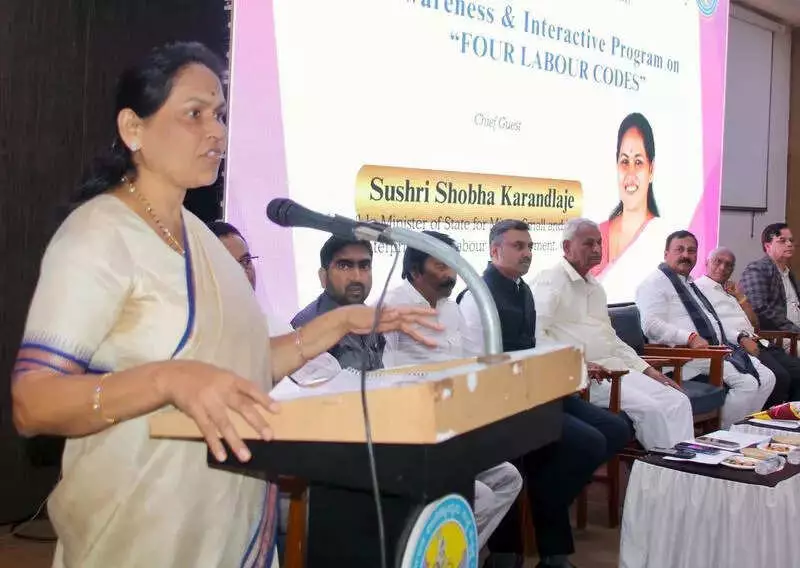
Union Minister of State for Micro, Small and Medium Enterprises, Labour and Employment, Shobha Karandlaje, made a significant announcement on Monday. She declared that unorganised workers across India will receive enhanced social security schemes in the near future. This move aims to uplift millions of workers who currently lack formal protections.
Key Benefits for Workers
Karandlaje specifically highlighted the extension of ESI (Employees' State Insurance), EPF (Employees' Provident Fund), and pension schemes to unorganised workers. She emphasised that the Union government has already formulated plans to provide more benefits for this workforce. "Already, the Union govt has made plans and discussed providing more benefits for the workers," she stated confidently.
The minister shared this information during an awareness and interactive programme on the Four Labour Codes. The event was organised by the Karnataka Chamber of Commerce and Industry (KCCI) in Hubballi. It brought together industry representatives, officials, and stakeholders to discuss the new regulations.

Massive Registration on E-shram Portal
Karandlaje revealed an impressive statistic: 31 crore unorganised workers have self-registered on the E-shram portal. This digital platform serves as a crucial database for identifying and supporting workers in the informal sector. The high registration numbers indicate widespread awareness and participation among the labour force.
Rationalisation of Labour Laws
The Four Labour Codes, which took effect from November 21 last year, represent a major overhaul of India's labour regulations. These codes rationalise 29 existing labour laws that were originally implemented during British rule. Karandlaje pointed out that these old laws were designed for colonial convenience and control over labourers.
She explained that although changes were expected after independence, the process faced delays. It was only after Prime Minister Narendra Modi's government came to power that serious discussions on reforming labour laws began. The minister noted that around 1,500 outdated laws and Acts have been removed, but revising labour codes required careful handling due to the involvement of crores of workers.
Collaborative Development of Labour Codes
Karandlaje described how the new labour codes were developed through extensive consultation. The government engaged with states, trade unions, state labour ministers, and various stakeholders. A brief study was conducted to gather inputs and address concerns. "By taking the confidence of states, trade unions, state labour ministers, stakeholders, and through a brief study, labour codes were made," she said.
She added that 95% of states have shown support for the four codes, though some queries and doubts still need clarification. The codes are designed to align with Indian values, industries, and workers' needs. Their purpose is not to create conflict between owners and labourers but to foster national development and achieve the vision of Viksit Bharat by 2047.
Support from Local Leaders and Officials
MLA Mahesh Tenginakai also spoke at the event, emphasising how the four codes strengthen industries. He discussed the importance of business-friendly labour laws in driving economic development. His remarks underscored the collaborative effort between government and industry to create a conducive environment for growth.
Deputy Labour Commissioner (Central) Regional Head SK Mohanty provided comprehensive information on the practical aspects of the four labour codes. Using a PowerPoint presentation, he detailed implementation measures and regulations that industries must follow. His session offered valuable insights into the operational side of the new laws.
Interactive Discussion and Participation
The programme featured an interactive discussion, allowing participants to ask questions and share perspectives. This engagement highlighted the community's interest in understanding and implementing the labour codes effectively.

Several dignitaries attended the event, including KCCI Hubballi President GK Adappagoudar, Vice-Presidents Praveen Agadi and Siddeshwar Kammar, and Secretary Uday Revankar. Their presence demonstrated the local business community's commitment to adopting the new regulations.
The Four Labour Codes focus on improving working conditions, safety, wages, social security, and overall welfare for workers. By streamlining numerous laws into four comprehensive codes, the government aims to create a more efficient and equitable labour ecosystem. This initiative marks a significant step towards empowering unorganised workers and integrating them into the formal economy.