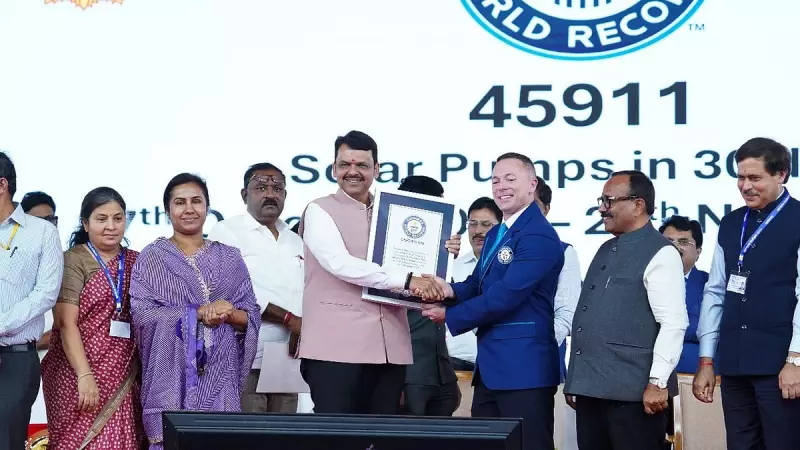
In a landmark achievement for renewable energy and agricultural sustainability, the state of Maharashtra has officially set a new world record for the installation of solar-powered irrigation pumps. The announcement was made by Chief Minister Devendra Fadnavis, who highlighted the state's accelerated transition toward eco-friendly farming solutions.
A Vision Powered by PM-KUSUM
Chief Minister Fadnavis attributed this historic accomplishment to the transformative PM-KUSUM (Pradhan Mantri Kisan Urja Suraksha evam Utthaan Mahabhiyan) initiative, spearheaded by Prime Minister Narendra Modi. He stated that the central government's guidance has been instrumental in fast-tracking this clean energy shift, which directly benefits the farming community.
The scheme's core objective is to replace diesel and grid-electricity dependent pumps with solar energy systems. This move not only reduces the carbon footprint of agriculture but also aims to provide farmers with a reliable and cost-effective source of power for irrigation, enhancing their energy security and financial independence.

Details of the Record-Breaking Feat
The official announcement was made on 07 December 2025. While the precise number of pumps installed to secure the world record was not detailed in the initial report, the achievement underscores Maharashtra's position as a leader in adopting solar technology for agricultural use.
This initiative represents a significant step in India's commitment to expanding its renewable energy capacity while addressing critical needs in the agrarian sector. The state's administration has focused on implementing the scheme efficiently to reach a maximum number of farmers across its regions.
Implications for Farmers and Clean Energy Goals
The success of this large-scale deployment has several positive consequences. For farmers, it translates to lower operational costs for irrigation and protection against fluctuating diesel prices and grid power shortages. It empowers them with greater control over their water resources.
On a broader scale, this achievement contributes substantially to:
- Reducing greenhouse gas emissions from the agricultural sector.
- Decreasing the burden on conventional power grids.
- Advancing India's ambitious targets for solar energy generation.
- Creating a scalable model for other states to follow in promoting farmer-centric irrigation solutions.
The world record set by Maharashtra is more than a statistical milestone; it is a testament to the potential of targeted government schemes in driving tangible, on-ground change. It aligns with a dual national priority: bolstering farmer welfare and pursuing a sustainable energy future.