In a revealing trend from Karnataka's flagship unemployment assistance program, a significant majority of beneficiaries are graduates from non-engineering backgrounds. However, a concerning parallel development is the extremely low participation in the skill development training linked to the financial aid, according to state officials.
Yuva Nidhi: A Financial Lifeline for Graduates
Launched as a key promise under the Congress government's five guarantees, the Yuva Nidhi scheme provides a monthly stipend to educated youth who remain unemployed after completing their studies. Graduates receive Rs 3,000 per month, while diploma holders are entitled to Rs 1,500 per month. This financial support begins 180 days after graduation and continues until the beneficiary secures a job, for a maximum period of two years.
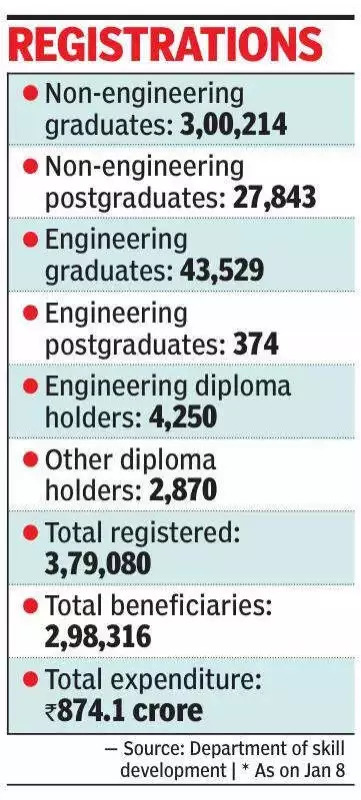
The scheme has seen substantial uptake across the state. As of recent data, more than 2.9 lakh young individuals are currently availing the allowance. The government has already disbursed a substantial Rs 874.1 crore under the initiative.

District-wise data shows Belagavi leading with the highest number of registrations at 45,884. It is followed by Kalaburagi (26,701), Vijayapura (23,474), Raichur (22,645), and Bagalkot (22,607). Bengaluru Urban, the state's capital and major IT hub, has 19,276 enrolled beneficiaries.
Who Are the Beneficiaries? The Non-Engineering Majority
An analysis of registrations until January 8 provides a clear picture of the educational background of the applicants. Out of over 3.7 lakh registered graduates, a staggering 79% (over 3 lakh) are graduates from non-engineering disciplines. These include streams like arts, science, commerce, and management. An additional 12% (27,843) are postgraduates from these same fields.
In contrast, engineering graduates account for a smaller portion. 43,529 engineering graduates and 374 postgraduate engineers have enrolled. Furthermore, 4,250 engineering diploma holders and 2,870 other diploma holders have also applied for the scheme.
The Yuva Nidhi Plus Conundrum: High Need, Low Participation
While the financial aid component is popular, the accompanying skill-enhancement initiative, Yuva Nidhi Plus, has failed to gain similar traction. This program is designed to offer employability-focused training through reputable institutions to make beneficiaries job-ready.
Training partners include:
- Centre for Entrepreneurship Development of Karnataka (CEDOK)
- Government Tool Room and Training Centre (GTTC)
- Karnataka German Technical Training Institute (KGTTI)
- Vocational training providers empanelled with the Karnataka Skill Development Corporation
Despite these opportunities, participation has been dismal. Sharan Prakash Patil, the Minister for Medical Education and Skill Development, highlighted the gap. "The programme was designed to train 25,000 beneficiaries. But not even 10% turn up for the courses," he stated.
Officials cite a major reason for this reluctance: beneficiaries fear that attending training might lead to the discontinuation of their monthly allowance. Minister Patil clarified, "Despite repeated follow-ups, many are reluctant, fearing they may lose the allowance during the training period. We have assured them this will not happen until they secure a job."
Addressing the Engineering Graduate Challenge
Minister Patil also drew attention to the situation of engineering graduates in the state. Karnataka produces approximately one lakh engineering graduates every year, but only about 20,000 to 25,000 manage to find employment annually. "Most struggle due to skill gaps," he admitted.
To bridge this gap, the government is taking proactive steps. It has invited companies to establish training centres within engineering colleges themselves, with the state bearing the cost of training. One such centre is already operational and running successfully at PES University, serving as a model for future collaborations.

The Yuva Nidhi scheme, therefore, presents a dual narrative: it is successfully providing crucial financial support to a large number of unemployed youth, predominantly from general education streams. Yet, it simultaneously faces the critical challenge of motivating these same beneficiaries to upgrade their skills, which is essential for their long-term employment prospects and the scheme's ultimate goal of creating a employable workforce.