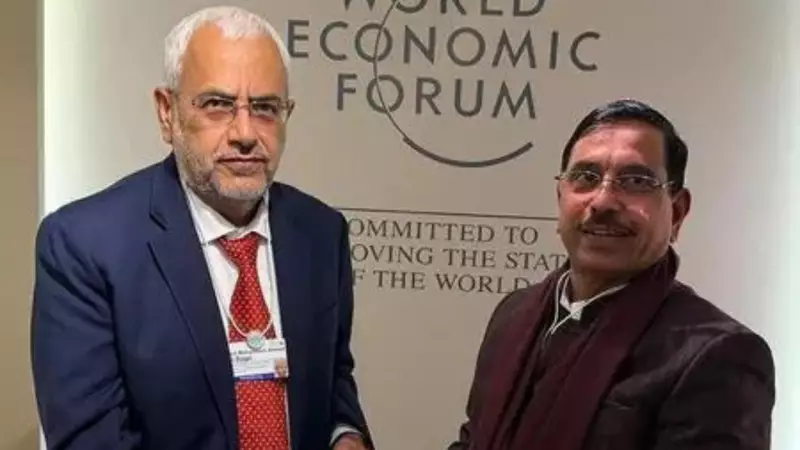
NEW DELHI: India has made a compelling pitch for a massive $300 billion investment opportunity in its burgeoning green energy sector to international investors gathered at the World Economic Forum in Davos. Union Minister Pralhad Joshi, who recently attended the WEF 2026 summit in Switzerland, revealed this ambitious target on Thursday, positioning India as a premier destination for clean energy capital.
India's Clean Energy Vision Takes Center Stage at Davos
During his participation in multiple sessions and investor meetings at the prestigious global forum, Minister Joshi emphasized that rapidly declining renewable energy tariffs, comprehensive grid modernization initiatives, and increasingly competitive storage and green hydrogen prices have transformed clean energy into a cornerstone of India's economic growth strategy. He utilized the influential WEF platform to directly engage with global investors, showcasing India as one of the world's largest and most investment-ready clean energy markets.
Substantial Capital Requirements by 2030
The minister outlined that India's green energy transition requires an estimated capital infusion of $300 to $350 billion by the year 2030. This substantial investment need presents what Joshi described as "one of the most significant opportunities in the global energy landscape today." He stressed that India's energy transition offers investors a unique combination of speed, scale, stability, and promising long-term returns at a time when global capital is actively seeking predictable growth opportunities.

Impressive Progress and Future Targets
In various forum sessions, Joshi highlighted India's remarkable achievement of building 267 gigawatts of non-fossil fuel capacity to date. He confidently asserted that the nation remains "firmly on track" to meet its ambitious 2030 clean energy targets. The minister pointed to several key factors that make India particularly attractive for long-term global investment, including massive domestic energy demand, consistent policy certainty, a rapidly expanding manufacturing base, and strong execution capabilities at both national and state levels.
Strategic Bilateral Engagements
According to an official ministry statement, Minister Joshi engaged in numerous bilateral meetings on the sidelines of the Davos forum with global investors and leading energy companies. These discussions specifically focused on exploring investment opportunities across various segments of India's renewable energy ecosystem. Key areas of interest included green hydrogen-linked infrastructure development, renewable energy projects integrated with advanced battery storage systems, and comprehensive grid modernization initiatives.
A Comprehensive Investment Proposition
The minister's presentation at Davos presented a comprehensive investment proposition that combines India's enormous market potential with concrete policy frameworks and implementation capabilities. Joshi emphasized that India's approach to energy transition addresses multiple investor priorities simultaneously—offering both environmental sustainability and robust financial returns. This dual appeal positions India's green energy sector as particularly compelling in the current global investment climate, where environmental, social, and governance (ESG) considerations are increasingly influencing capital allocation decisions.
The Davos pitch represents a strategic effort to position India at the forefront of the global energy transition while addressing the substantial capital requirements necessary to achieve the nation's ambitious clean energy goals. With falling technology costs and supportive policy frameworks, India's renewable energy sector appears poised for accelerated growth, offering global investors what Minister Joshi described as "a rare combination of scale, stability, and sustainable returns."