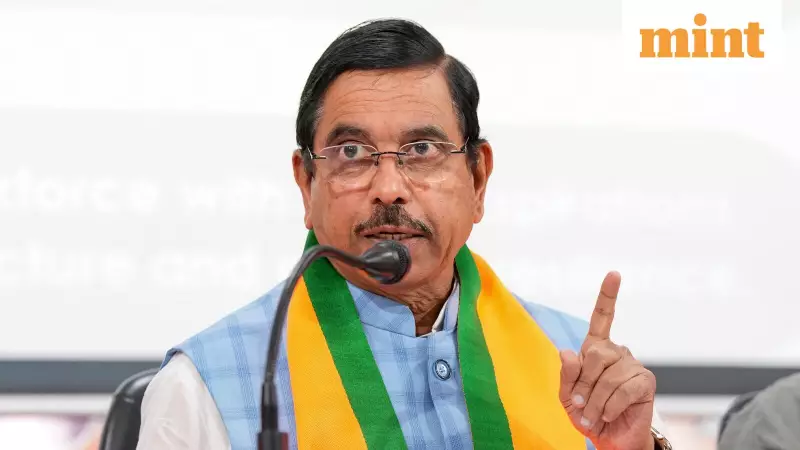
New Delhi: India has unveiled a substantial $300-350 billion green energy investment opportunity extending until 2030, presenting global investors with a predictable and stable ecosystem for sustainable growth. Union Minister Pralhad Joshi, addressing international stakeholders at the World Economic Forum 2026 in Davos, emphasized the nation's readiness to become a premier destination for clean energy capital.
India's Energy Transition: Speed, Scale, and Stability
According to a ministry statement released on Thursday, Joshi, who serves as the Minister for New and Renewable Energy, articulated that India's energy transition offers unprecedented speed, scale, stability, and long-term returns. This comes at a crucial time when global investors are actively seeking predictable growth opportunities in the renewable sector.
The ministry further reinforced Joshi's message by declaring India as the "world's largest and most investment-ready clean energy markets". This assertion was made during multiple sessions and meetings with global executives at the prestigious Davos forum, highlighting the country's strategic positioning in the international green economy.

Current Capacity and Future Targets
Minister Joshi provided concrete data to support India's investment proposition, revealing that the nation has already established 267 GW of non-fossil fuel capacity as of December 2025. This significant achievement places India firmly on track to meet its ambitious 2030 clean energy targets, which include reaching 500 GW of renewable energy generation capacity by the end of this decade.
Bilateral Engagements and Sector Focus
On the sidelines of the World Economic Forum, Joshi conducted several bilateral meetings, actively urging global companies to explore diverse investment avenues within India's renewable energy landscape. Key areas of focus included:
- Green hydrogen-linked infrastructure development
- Renewable energy projects integrated with battery storage solutions
- Comprehensive grid modernization initiatives
Addressing Transition Challenges
While India aggressively promotes its renewable sector to international investors, the energy transition space faces notable obstacles despite rapid capacity installation and growing local manufacturing capabilities. Current challenges include:
- Approximately 43 GW of renewable energy capacity remains uncontracted
- Clean power curtailment issues in solar-rich states like Rajasthan and Gujarat
Global Cooperation and Multilateral Dialogue
During the Davos meetings, Joshi also engaged with Borge Brende, President and CEO of the World Economic Forum, alongside Union Minister Ashwini Vaishnaw. Their discussions centered on:
- The critical importance of global cooperation in addressing shared economic and developmental challenges
- The role of multilateral platforms like WEF in building global consensus
- The necessity for sustained dialogue between governments, industry, and stakeholders to advance sustainable, resilient, and inclusive growth across energy and development sectors
Joshi highlighted on social media platform X that India combines substantial demand with policy certainty, a rapidly expanding manufacturing base, and strong state-level execution capabilities. These factors collectively create an attractive environment for long-term global capital investment.
Solar Manufacturing Capacity and Localization Efforts
India's solar manufacturing infrastructure demonstrates significant growth, with current capacities including:
- Over 100 GW of solar module manufacturing capacity
- Approximately 18 GW of solar cell production capacity
In alignment with localization initiatives, the government is exploring strategies to encourage domestic manufacturing of critical sub-components such as wafers, ingots, and polysilicon. Beyond the existing ₹24,000 crore production-linked incentive scheme for solar modules and cells, authorities are developing separate incentive plans specifically targeting wafer and ingot manufacturing.

Innovative Financing Models
Minister Joshi encouraged global investors to consider innovative financing approaches, including:
- Long-term patient capital investments
- Blended finance models to support large-scale renewable deployment
The Ministry of New and Renewable Energy is actively evaluating various financing mechanisms, including contract for difference arrangements for power-purchase agreements. These may potentially replace conventional long-term pacts spanning up to 25 years. Under CfD models, either party compensates for the difference between contracted and actual prices. Additionally, the ministry is considering mezzanine finance structures that combine debt and equity elements.
Global Investment Context
According to the International Energy Agency's World Energy Investment 2025 report, renewable energy investment has surged dramatically, accounting for more than half of total non-fossil investment over the past five years. The report specifically noted that in 2024, 83% of power sector investment flowed into clean energy projects.
Significantly, India emerged as the world's largest recipient of development finance funding in 2024, receiving approximately $2.4 billion in project-type interventions specifically targeting clean energy generation. This underscores the global confidence in India's renewable energy trajectory and its potential for delivering substantial returns on green investments.