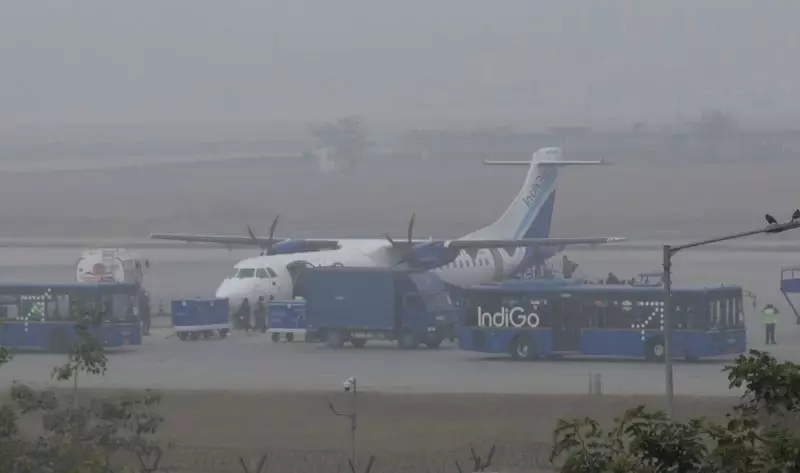
The dense winter fog that blankets North India annually brings with it a familiar scene of chaos at major airports. Thousands of passengers face flight delays, cancellations, and immense frustration as aviation operations grind to a near halt. While fog is a predictable annual phenomenon, the recurring scale of disruption points to a systemic lack of preparedness in India's aviation infrastructure.
The Core of the Crisis: Missing and Mismanaged Technology
At the heart of the problem lies a critical shortage of advanced landing systems. For an aircraft to land safely in very low visibility conditions—specifically when the runway visual range (RVR) drops below 550 meters—it requires a Category III (CAT III) Instrument Landing System (ILS). This sophisticated technology guides planes down to the runway with precision using radio signals, independent of the pilot's visual reference.
However, a stark reality is that out of India's 137 operational airports, only 29 are equipped with CAT III-compliant infrastructure. The issue deepens when considering that even among these, not all have the full suite of technology or trained personnel operational. Major hubs like Delhi's Indira Gandhi International Airport (IGI) have CAT IIIB systems, allowing landings in RVR as low as 50 meters. Yet, other crucial airports in the fog-affected belt lack similar capabilities.

Furthermore, the technology is only one part of the equation. The aircraft itself must be CAT III-compliant, and the pilots require rigorous, certified training to execute such low-visibility landings. A mismatch in any of these three elements—airport, aircraft, or pilot—renders the system ineffective.
Operational Shortfalls and Regulatory Challenges
Beyond hardware, operational protocols often exacerbate the situation. The Directorate General of Civil Aviation (DGCA) mandates specific RVR minima for take-offs and landings. During dense fog, these limits are strictly enforced, leading to a cascading effect of delays. The process of de-icing aircraft in cold, foggy conditions adds further time.
A significant bottleneck is the limited number of runways equipped with CAT III. At busy airports, only one or two runways might be fog-ready, creating a massive backlog of aircraft waiting for clearance. This congestion is compounded by the fact that not all airlines invest equally in training a large pool of CAT III-qualified pilots, making them dependent on a limited crew during crises.
Coordination between the Airports Authority of India (AAI), airlines, and the Indian Meteorological Department (IMD) also faces stress during peak fog periods. While IMD provides forecasts, the rapid onset and shifting density of fog can outpace the ground handling and flight scheduling mechanisms, leading to last-minute chaos and stranded passengers.
The Path Forward: Solutions and Systemic Overhaul
Addressing this annual crisis requires a multi-pronged strategy and significant investment. The primary solution is the aggressive expansion of CAT III ILS systems to all major airports in fog-prone regions, including Amritsar, Lucknow, and Kolkata. This must be treated as essential infrastructure, not an upgrade.
Simultaneously, regulatory bodies like the DGCA need to incentivize and enforce better preparedness from airlines. This includes mandating a higher ratio of CAT III-trained pilots per fleet and ensuring aircraft are consistently maintained for low-visibility operations. Investing in alternative technologies like Ground-Based Augmentation System (GBAS), which can serve multiple runways at once, should also be explored.
On the operational front, airports must refine their passenger communication and facilitation protocols during delays. Clear, real-time information and robust contingency plans for accommodating passengers are non-negotiable components of modern aviation.
In conclusion, the annual fog disruption is more than a weather problem; it is a mirror reflecting gaps in India's aviation planning and investment. As passenger traffic grows, solving this issue through technological deployment, trained human resources, and seamless coordination is crucial for the reliability and reputation of Indian air travel.