

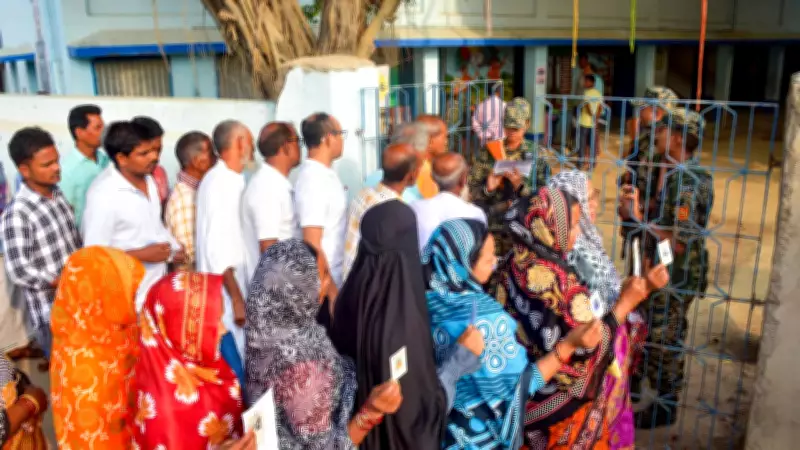
The record-breaking polling percentages in West Bengal and Tamil Nadu, at 92.9% and 85.1% respectively, serve as yet another validation of the special intensive revision (SIR) exercise, according to Election Commission officials. This achievement comes despite persistent doubts raised by certain political parties and underscores the public's unwavering trust in the electoral process.
Turnout Comparisons and Historical Context
The overall turnout in these states has surpassed the 84.7% and 78.3% recorded in the 2011 assembly elections for West Bengal and Tamil Nadu respectively. The only other state in independent India to register a higher overall turnout than West Bengal's 92.9% — which is not final, as another phase of polling is scheduled for April 29 — is Tripura. The northeastern state recorded 93.6% polling in the 2013 assembly elections. However, Tripura's turnout is based on an aggregate of EVM votes and postal ballots, whereas West Bengal's percentage is calculated solely on EVM votes.
Female Voter Participation
Female participation was higher than male voter turnout and also the highest ever recorded in both states. In West Bengal, 92.7% of women voted compared to 90.9% of men, while in Tamil Nadu, female turnout at 85.7% surpassed the male turnout of 83.6%. The previous highest female turnout in Bengal was 84.4% in the 2011 election, and in Tamil Nadu it was 78.5%.

Chief Election Commissioner Gyanesh Kumar expressed appreciation for the highest ever polling percentages in the two states, stating, "EC salutes each voter of West Bengal and Tamil Nadu." Another EC functionary described the record turnout as "a watershed moment" for West Bengal. In contrast to past elections marked by large-scale political violence, only a few minor incidents were reported on Thursday.
"Just as poll violence in Bihar is now a thing of the past, the 2026 polls will usher in a change in Bengal too," the functionary added.
Impact of Special Intensive Revision
The SIR initiative, piloted by CEC Kumar to purify electoral rolls starting with Bihar last year, tends to automatically boost voting percentages due to a reduced total electorate. "After the dead, permanently shifted, and doubly enrolled electors are removed from the rolls, even if the same number of people vote, the polling percentage is higher. Additionally, these electors, having gone through the verification process during SIR, realize the importance of their vote and exercise it consciously," an EC officer explained.
Measures Against Electoral Malpractices
The EC is rigorously monitoring common electoral malpractices in Bengal, such as chaapa, source jamming, and booth jamming, through a three-point verification system for all persons entering polling stations. Section 163 of the BNSS (corresponding to Section 144 of the erstwhile IPC) was imposed on Thursday within a 200-meter radius of polling stations. Identity papers of each person entering this area were checked, allowing only genuine electors, election officials, and others to enter. A second check at the polling booth involved BLOs and NCC volunteers confirming the identity of not only pardanasheen women electors but everyone before they queued to vote. Finally, the polling officer verified the elector's identity a third time before the vote was cast.
"Nobody is being stopped from voting, as was done earlier by anti-social elements backed by certain parties," an EC officer stated.






