

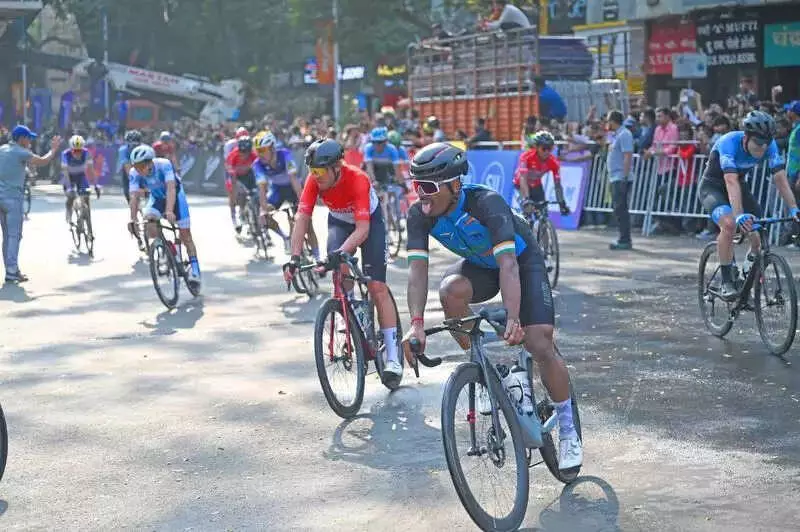
Pune's Grand Tour Success Highlights Deepening Infrastructure Divide
The Pune Grand Tour brought significant international acclaim to the city, with the administration receiving widespread praise for its flawless execution of the prestigious event. However, this global showcase has simultaneously exposed a troubling and stark divide in Pune's urban infrastructure, revealing a tale of two cities within the same municipal boundaries.
Selective Facelift: World-Class Routes Amidst Pothole-Ridden Neighborhoods
For a city frequently mocked for having potholes comparable to "lunar craters", the Grand Tour routes presented roads that genuinely matched world-class standards. Yet this impressive facelift proved to be highly selective and geographically limited. Residents from Hadapsar, Kharadi, Cantonment areas, and various eastern pockets of Pune have voiced strong complaints, alleging they have been completely abandoned by the Pune Municipal Corporation simply because no Grand Tour routes passed through their neighborhoods.
This pattern of "event-driven" repairs is not new to Pune. In May 2023, ahead of the G20 summit, the PMC renovated fifteen major arteries including the Solapur Highway. Today, those same roads have deteriorated back to precarious conditions, featuring:

- Uneven patches and dangerous potholes
- Poorly managed traffic flow
- Rapid degradation despite recent repairs
While global audiences witnessed sleek, modern visuals of Pune during the Grand Tour, local taxpayers are expressing mounting frustration over the temporary nature of these improvements. The contrast between international perception and ground reality has become increasingly difficult for residents to accept.
Official Explanations and New Policies
Aniruddha Pawaskar, chief engineer of the roads department, attributed the rapid deterioration to constant excavation work. "The biggest culprits are frequent digging by various PMC departments for water pipelines and storm drains, as well as external agencies like the police department for CCTVs and MNGL for gas lines," Pawaskar explained. "Massive infrastructure work is constantly compromising road integrity."
In response to these challenges, Omprakash Divate, additional municipal commissioner (special), announced a strict new policy to protect the newly paved tour routes. "Prior to the tour repairs, we held a meeting with all utility agencies led by the commissioner. They were given written instructions: no permission will be granted to dig up these newly asphalted roads for at least three years," Divate stated. He emphasized that the civic body would no longer be liberal with permits and would impose heavy penalties for unauthorized excavation.
Pawaskar further clarified that agencies were provided with a 45-day window to complete their work before the asphalting process began. "Once a road's strength is compromised by digging, water seeps in and it cannot be fully restored. We intend to keep these specific roads intact," he affirmed.
Resident Frustrations and Calls for Accountability
Despite these official assurances, residents living outside the designated "prestige zones" remain deeply skeptical. Sriniwas Vardha, a resident of Hadapsar, questioned the PMC's internal coordination capabilities. "If PMC cannot coordinate between its own departments, how can they claim to run the city? Before the G20, they planted decorative shrubs and fixed the roads; today, the plants are dead and the roads are worse than before."
Tanishk Ameta, a resident of Mundhwa, echoed these concerns while calling for greater accountability over mere aesthetics. "Why does the PMC need an international event to provide safe roads? It's heartbreaking to see world-class images of Pune online when we know people are still losing their lives to potholes in the neglected areas. The PMC must stop giving excuses. Taxpayers deserve safe roads every day, not just when the world is watching."
The Grand Tour has thus become a catalyst for broader conversations about equitable urban development, sustainable infrastructure maintenance, and the responsibilities of municipal governance beyond temporary event preparations.






