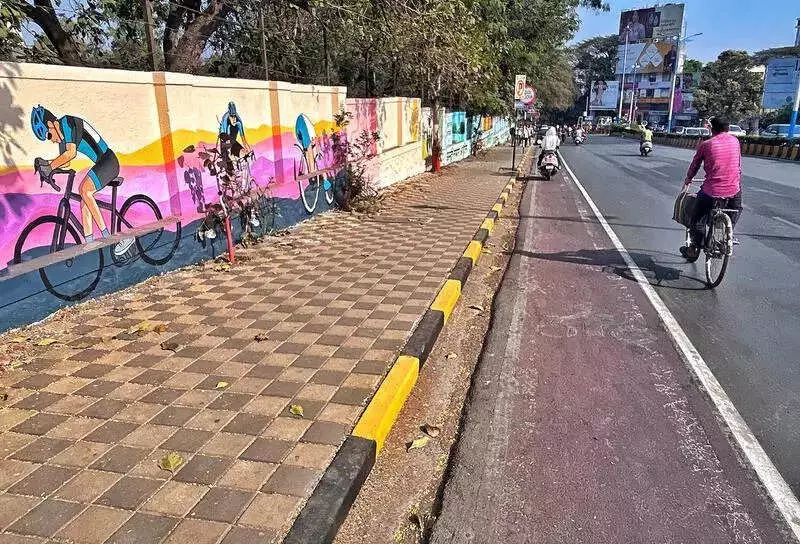
Pune's Cycling Infrastructure Receives Much-Needed Boost from Grand Tour 2026
The arrival of the Bajaj Pune Grand Tour 2026 has provided a significant opportunity for Pune and Pimpri Chinchwad's cycling infrastructure to receive a much-needed enhancement, according to local cyclists and urban planning experts. Many roads in the area are now the smoothest they have been in years, but observers emphasize that provisions must be made to maintain this improved condition over the long term.
The Decline of Cycling in Pune
Over the past few decades, cycling has transformed into a tedious and often dangerous activity for city-based enthusiasts, particularly over long distances. Cyclists face numerous daily challenges, including:
- Lack of continuity in cycling tracks
- Obstructions from encroachments and parked vehicles on painted cycle lanes
- Uneven road surfaces
- Unforgiving motorists who disregard cyclist safety
This represents a stark contrast to Pune's past reputation as a Pensioner's Paradise, where roads wound through massive green canopies, traffic was minimal, and pothole-free stretches encouraged both cycling and walking. As the city expanded, its character fundamentally changed.

Expert Perspectives on Current Challenges
Neeraja Kandala, a longtime cyclist and owner of a cycling initiative, told TOI that she has witnessed the most significant changes in pursuing this sport over the last seven or eight years. This is largely due to increasing traffic and a steady decline in tree cover, which provides essential shade to cyclists. In Pune, road design actively discourages cycling, even on newly constructed routes, she explained.
Kandala highlighted specific problem areas: On several stretches where Metro construction and road widening are ongoing, such as Ganeshkhind Road, no safe alternatives are provided for cyclists or pedestrians. Diversions are routinely planned for motorised vehicles during such infrastructure work, but non-motorised commuting is completely ignored.
She added, A decade ago, the city had far more trees, which made cycling possible even during peak summer. Today, with green cover gone across areas, cycling in extreme heat is unrealistic. Infrastructure integration with public transport, more cycle trails and segregated cycle-tracks that have some semblance of connectivity are essential to encourage the activity again.
Historical Context and Implementation Failures
In 2017, Pune made history as the first Indian city to develop a Comprehensive Bicycle Plan (CBP). However, a 2025 cycling track audit report by Parisar revealed that having infrastructure plans on paper and limited implementation on the ground does not necessarily translate to usable facilities. Missing safety measures, inadequate maintenance, and poor connectivity have become primary reasons why cyclists are abandoning their preferred mode of transport for mechanized alternatives.
Tanzeel Allapur, who conducted the 2025 Parisar audit, stated, The core problem is that cycling is still not treated as a serious mode of transport in our system. Cycle tracks are often built as a 'one-time project' or a cosmetic add-on, not daily transport infrastructure that needs regular maintenance, monitoring, and protection.
Recent Studies and Persistent Issues
The Institute for Transport and Development Policy (ITDP) India recently conducted a survey across Pune and Pimpri Chinchwad, examining cycling infrastructure and the challenges faced by cyclists. Pranjal Kulkarni, programme manager at ITDP India, shared findings: On-ground observations and user feedback from the study show that cycling is very much present on streets of both cities, especially during peak hours. A large share of residents continue to cycle regularly, many for daily, non-recreational trips such as commuting, education, and local errands. But the findings indicate that infrastructure availability alone has not translated into safe or reliable cycling conditions.
Kulkarni identified several persistent challenges:

- Obstructions on cycle tracks: A majority of cyclists report that tracks are frequently blocked by parked vehicles, vendor encroachments, and even moving motor traffic, reducing both safety and usability.
- Lack of continuity: Cycle tracks often end abruptly, merge into footpaths, or lose segregation at junctions and bottlenecks, forcing cyclists to repeatedly enter mixed traffic.
IT professional Ketan Tendulkar, who has cycled for commuting around Pune for nearly two decades, agreed: Pune is not a safe city to cycle in, but it can be. Something as simple as keeping the cycle tracks clear of encroachments is the first and most crucial step.
Safety Concerns and Infrastructure Gaps
The ITDP study further highlighted that safety concerns remain particularly high on wider, high-speed corridors. While painted cycle lanes offer basic continuity but no physical protection, physically segregated tracks lose effectiveness when continuity and enforcement are missing.
Parisar's December 2025 cycle track audit report revealed that results from their latest audit and a similar one conducted fourteen years earlier were identical—lack of continuity and poor safety remain the top issues faced by cyclists across Pune. The fresh audit, conducted between April 2025 and March 2025, covered 83 kilometers and focused on three main criteria: comfort, continuity, and safety, while also inviting citizen participation in the evaluation process.
Official Response and Counterarguments
Authorities have sometimes blamed citizens for underutilizing existing cycle tracks. Allapur countered this perspective: That is exactly the wrong way to look at it. Infrastructure is not successful because people are heroic enough to use it; it is successful when ordinary people feel safe and comfortable using it. If people are not using these tracks, it is a design and maintenance failure, not a failure of citizens.
Anirudha Pawaskar, Chief Engineer (Roads) at PMC, provided official commentary: The roads targeted for the cycle tour are under contract now; we will not be giving permission for any kind of digging to be done on this 75km stretch. Constant digging is one of the main reasons roads become bad. It is the responsibility of the police and PMC to ensure that there are no obstacles on tracks. This is what breaks lane continuity. That said, there are very few people who use cycle tracks. They prefer using the roads instead.
Pathways to Improvement
Experts emphasize that to make existing investments truly effective, civic bodies in Pune and Pimpri Chinchwad must shift focus from merely creating infrastructure to ensuring continuity, protecting cycle space, and strengthening enforcement. Kulkarni suggested specific measures: Improving junction design, maintaining clear segregation on high-speed roads, adopting smooth riding surfaces and implementing traffic calming on shared streets will be critical to making cycling safe and dependable here.
He added an important comparison: Whatever infrastructure is built has to be done in a manner that not only caters to current cyclists but also encourages new ones. When Metro footfall doesn't live up to promises, the network is expanded, not ignored. That is exactly how cycling has to be promoted as well. Pune used to be very cycle-friendly. In fact, it was a model for other cities. Today, while cities like Pimpri Chinchwad that learned from Pune are doing a better job, the latter is severely lacking.
Comprehensive Solutions Needed
Tendulkar summarized the multifaceted approach required: There is also a need for the mindset of citizens to change, which can be done through multiple avenues. In addition to encroachment-free tracks and continuity, offices could offer incentives to those who cycle to work. Several of my colleagues and I cycle to work and have the provision to shower or freshen up in the office and even a dedicated cycle parking space. A multifaceted approach is the only way, along with infrastructure building and upkeep, to make the city cycle-friendly again.
The Bajaj Pune Grand Tour 2026 represents a significant opportunity, but sustainable improvements will require coordinated efforts across infrastructure development, maintenance, enforcement, and community engagement to restore Pune's cycling-friendly reputation.