Odisha Chief Minister Unveils Star-Rating System for School Road Safety
Chief Minister Mohan Charan Majhi launched a new star-rating system for educational institutes in Bhubaneswar on Monday. This initiative aims to enforce road safety norms and cut down accidents near school and college zones across Odisha.
Addressing a Critical Safety Issue
The government prepared a detailed Standard Operating Procedure for school zone safety. This SOP outlines specific requirements and evaluation criteria for institutes. Educational institutions that earn between two and five stars will receive formal recognition and felicitation each year.
This move comes as a direct response to alarming accident statistics. During 2024 alone, at least 815 road accidents occurred near educational institutes in the state. These incidents resulted in 272 deaths and left 635 school and college students injured.

"Road safety represents a priority area for our government and connects directly to good governance," CM Majhi stated. "We will honor those districts and educational institutions that adopt the best road safety measures."
How the Star-Rating System Will Work
The state government will develop a comprehensive traffic engineering and management system as part of the SOP. Officials plan to create necessary traffic-related infrastructure and adopt traffic-calming measures. They will also earmark dedicated footpath zones, cycle tracks, and multi-utility zones around schools.
On a trial basis, authorities already installed traffic infrastructure and signage at Bhabagrahi Model School and Capital High School in Bhubaneswar. Effective implementation will require sustained institutional ownership and significant behavioral change, according to officials.
Schools will serve as focal points for road safety initiatives involving multiple stakeholders. These include students, parents, enforcement agencies, and the broader community.
Assessment and Implementation Process
Field officials will use a Google Forms-based assessment tool to record compliance. They will upload geo-tagged photographs to ensure uniform data capture across all districts. The State Transport Authority will notify institutes about the rating process and allow them two months to implement prescribed measures.
After this period, joint inspections will take place. District education officers and motor vehicle inspectors will conduct these inspections together. They will assign scores based on thorough on-ground verification and photographic documentation.
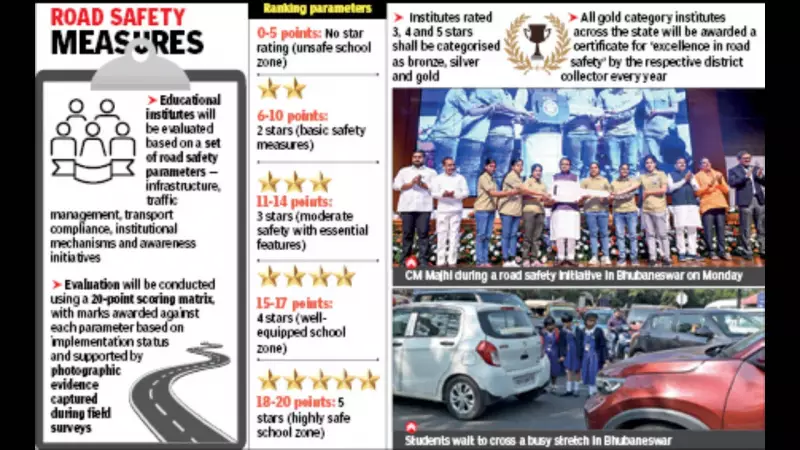
Institutes will face assessment on a structured set of parameters covering five key areas:
- Infrastructure
- Traffic management
- Transport compliance
- Institutional mechanisms
- Awareness initiatives
A 20-point scoring matrix supported by photographic evidence will determine the final ratings.
Rating Categories and Recognition
The scoring system breaks down into clear categories:
- Institutes scoring 0-5 points will receive no rating.
- Those scoring 6-10 points will earn a '2-star' rating for basic safety measures.
- Scores of 11-14 will receive '3 stars'.
- Scores of 15-17 will earn '4 stars'.
- Institutes achieving 18-20 points will be rated '5 stars'.
Further categorization will recognize top performers. Institutes getting 3, 4, and 5 stars will be classified as bronze, silver, and gold categories respectively. All gold-category institutes in a district will receive an "Excellence in Road Safety" certificate from the district collector annually.
Student Involvement and Community Engagement
Among other innovative measures, schools will designate trained students as road safety ambassadors. These ambassadors will promote safe behavior among their peers. They will assist during peak traffic hours and support various awareness activities in their communities.
This student-led approach aims to create a culture of safety from within educational institutions. It empowers young people to become active participants in solving road safety challenges around their schools.

The star-rating system represents a comprehensive effort to institutionalize compliance with road safety parameters. It seeks to enhance accountability among educational institutions and ultimately improve safety outcomes in school and college zones throughout Odisha.