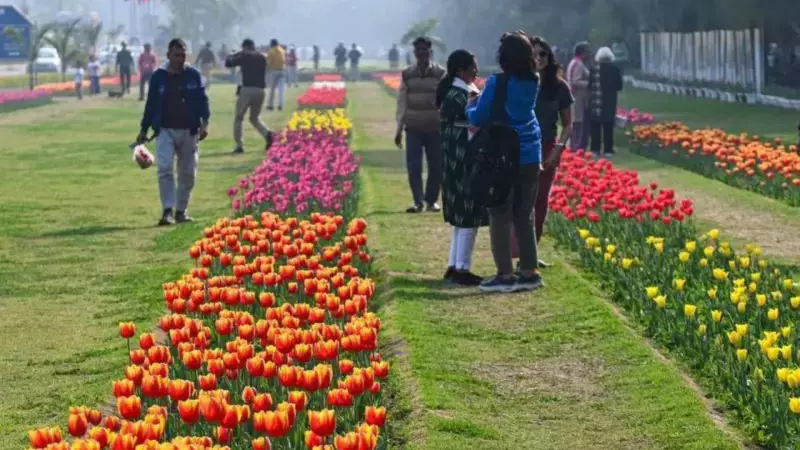
The New Delhi Municipal Council (NDMC) is set to transform the heart of the capital into a vibrant floral landscape with a massive tulip plantation drive. The council will begin planting over 2.6 lakh tulip bulbs across the Lutyens' Delhi area starting December 27. Announced by NDMC Vice Chairperson Kuljeet Singh Chahal on Thursday, this ambitious initiative aims to significantly enhance the city's visual appeal and contribute to pollution mitigation efforts.
Scale and Sourcing of the Floral Initiative
Detailing the plan, Chahal revealed that a total of 5.17 lakh imported Dutch tulip bulbs have arrived for the current season. Out of these, the NDMC has received 3.25 lakh bulbs, while the Delhi Development Authority (DDA) has been allotted 1.92 lakh bulbs. In a move highlighting conservation efforts, the NDMC will also plant an additional 15,000 tulip bulbs that have been preserved at the special conservation centre within the Tulip House in Lodhi Garden.
Furthermore, 20,700 tulip bulbs received from the CSIR-IHBT Research Centre in Palampur will be incorporated into the plantation drive. This marks a significant scaling up from previous years, with Chahal sharing procurement data: 62,800 bulbs in 2021-22, 1,40,210 in 2022-23, 2,00,000 in 2023-24, and 3,25,000 in the current 2024-25 cycle.

Focus on Religious Sites and Thematic Displays
A distinctive feature of this year's programme is its focus on beautifying major religious sites within the NDMC's jurisdiction. The council plans to adorn places of worship including Birla Mandir, Hanuman Mandir, and Bangla Sahib Gurudwara with dazzling tulip blooms. This will be achieved through a combination of ground plantations and artistic potted arrangements.
Beyond religious sites, the NDMC will create eye-catching thematic displays in public gardens and roundabouts. These displays are designed to convey social and national messages such as "Ek Ped Maa Ke Naam," "One Nation One Election," and "Viksit Bharat." Key locations identified for the plantation include Shanti Path, Central Park at Connaught Place, Lodhi Garden, and areas surrounding the Vice President's House.
Technical Planning and Public Engagement
Addressing the horticultural challenges, Chahal explained that tulip bulbs typically require a minimum temperature of around 5 degrees Celsius for nearly two months for proper germination. To overcome India's climatic conditions, the NDMC has procured pre-treated and programmed tulip bulbs that are capable of thriving despite temperature fluctuations.
In an effort to engage citizens directly, the council will make approximately one lakh potted tulip plants available for sale to the public. Residents can thus bring a piece of this beautification drive into their own homes. The flowers are expected to burst into bloom from February onwards, showcasing a spectacular palette of colours including white, yellow, red, pink, orange, and purple.
Chahal highlighted that the NDMC pioneered public tulip plantation in India, starting in the 2017-18 season. This floral drive is part of the council's broader green initiatives. Between April and October 2025, the NDMC planted over 3,400 trees and 29.9 lakh shrubs, including drives conducted at more than 20 foreign embassies under the "Ek Ped Maa Ke Naam" campaign, underscoring a comprehensive commitment to urban greening and environmental stewardship.