Nagpur Slum Dwellers Evicted Last Year Now Illegally Occupying Jaitala Open Space
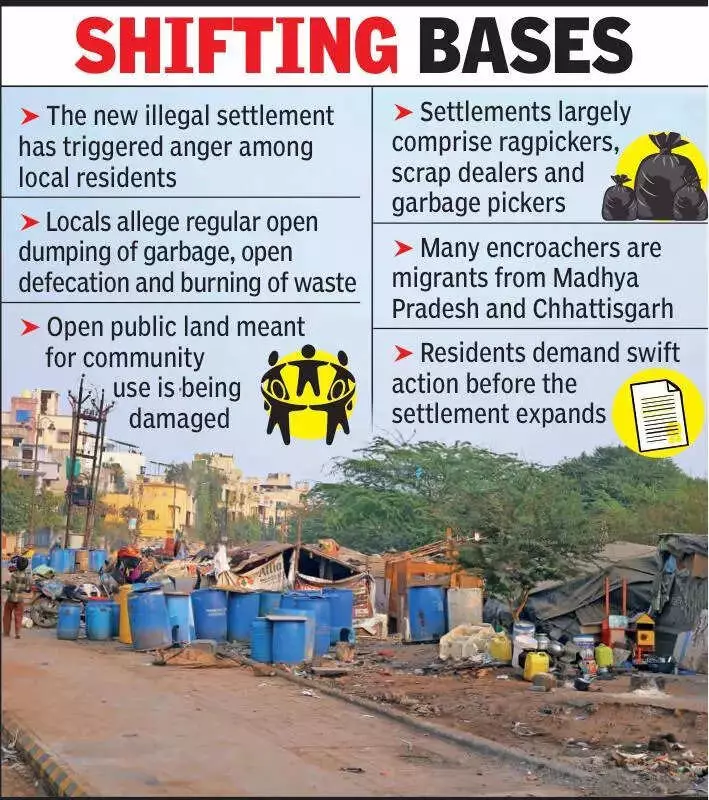
In a recurring urban challenge, slum dwellers who were evicted from a land parcel they had encroached near Sonegaon's Orange City Street in May last year have now illegally occupied an open space off Rajendra Nagar Road in Nagpur's Jaitala area. This new illegal settlement has sparked significant concerns among local residents, who report indiscriminate garbage disposal, open defecation, waste burning, and damage to public land intended for community use.
Persistent Encroachment Despite NMC Efforts
Despite repeated demolition and removal drives conducted by the Nagpur Municipal Corporation (NMC), illegal settlements continue to mushroom at new locations across the city. This pattern effectively nullifies anti-encroachment efforts, creating a cycle of displacement and reoccupation. The encroachers primarily consist of rag-pickers, scrap dealers, and garbage pickers, many of whom are said to have migrated from neighbouring states such as Madhya Pradesh and Chhattisgarh in search of livelihood opportunities.
Safety and Sanitation Concerns Voiced by Residents
Local residents have expressed growing anxiety over the situation. Amol Tidke, a resident of the area, highlighted that despite ambient lighting and regular traffic movement on Rajendra Nagar Road, pedestrians are hesitant to use it. "Women from our society avoid travelling alone here," he stated, underscoring safety issues. Priya Shende, a mother of a 15-year-old girl, added that she has observed slum dwellers loitering in the area even during daytime hours. "When my daughter comes back from school in the evening, I always go to pick her up," she said, reflecting the heightened vigilance among families.

The residents have urgently appealed to the NMC to act swiftly before the settlement expands further and becomes more entrenched, complicating future removal efforts.
Official Response and Civic Norms
According to established civic norms, such settlements cannot be regularised or legalised, especially when they emerge on government land or reserved open spaces. Officials maintain that allowing even temporary occupation only encourages further encroachments, setting a problematic precedent.
Harish Raut, Assistant Commissioner of NMC's encroachment department, explained that encroachment removal is an ongoing process. "If we remove an encroachment from place A, after some time, the same people shift to place B, and then to another location. This is a continuous cycle. As long as they keep shifting and occupying govt land, we will keep removing them," Raut said. He emphasised that open grounds, public plots, and reserved spaces cannot be allowed to be occupied illegally under any circumstances, reinforcing the corporation's stance on protecting public assets.
Urban Planners Warn of Broader Implications
Urban planners have issued warnings about the broader implications of unchecked encroachments. They note that such settlements not only strain civic resources but also deprive neighbourhoods of vital open spaces, thereby worsening environmental and public health conditions. With encroachments resurfacing across Nagpur, the issue has once again exposed the absence of a long-term rehabilitation strategy. Experts argue that without comprehensive solutions addressing housing and livelihood needs, the cycle of eviction and re-encroachment is likely to persist, undermining urban development and community well-being.
The situation in Jaitala serves as a microcosm of larger urban management challenges, highlighting the need for coordinated efforts between civic authorities, policymakers, and community stakeholders to find sustainable resolutions.