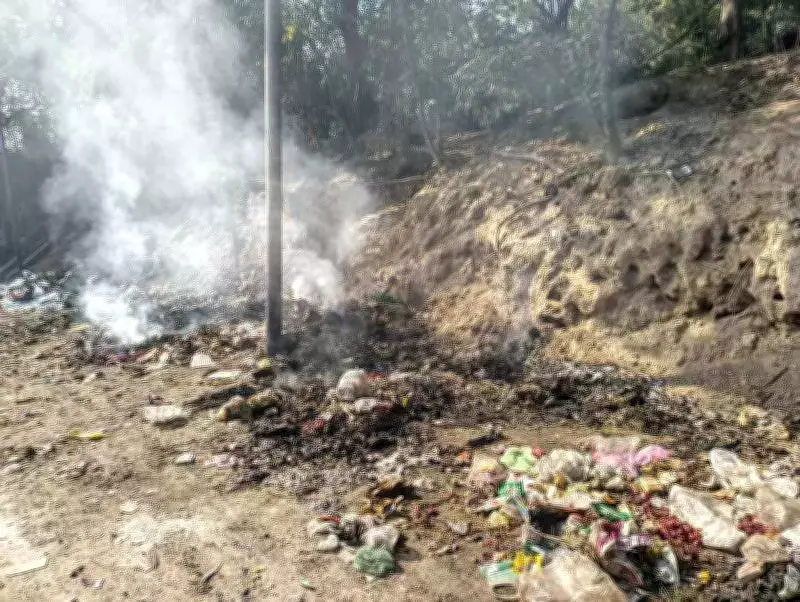
Open Garbage Burning Defies Lucknow Municipal Corporation Ban
Despite explicit prohibition under the Solid Waste Management Rules by the Lucknow Municipal Corporation, the illegal practice of burning garbage in the open continues unabated across numerous localities in the city. A comprehensive reality check conducted across over a dozen areas has revealed persistent violations, with piles of mixed waste—including plastic and dry leaves—being set on fire, particularly during early morning and late evening hours.
Widespread Violations Across Key Localities
The investigation covered prominent areas such as Indiranagar, Gomtinagar, Takrohi, parts of Mahanagar, the Pakka Pul stretch, the road near Integral University, Khadra, Chowk, and Kaiserbagh. In these locations, residents have reported irregular garbage lifting, leading to foul smells and thick smoke that make breathing difficult and pose significant risks to children, elderly individuals, and animals. Many complain that their grievances to authorities have yielded no tangible results.
Resident Testimonies Highlight Health Hazards
In Shantinagar Colony within Takrohi, garbage was found burning near Duda Colony, with residents noting that this occurs regularly, allowing smoke to infiltrate nearby homes. Sumit Singh, a local resident, described how smoke spreads during morning and evening hours, emphasizing that repeated complaints have failed to secure a permanent solution.

Similar issues were reported from Mahanagar and Vibhutikhand in Gomtinagar, where roadside waste and accumulated garbage heaps are frequently burned, often in open plots and near secondary collection points. One resident highlighted that burning typically happens in the evening, with smoke lingering for hours, making it impossible to keep windows open or venture outside.
Incidents of Panic and Environmental Damage
Near Mohan Meakin and Pakka Pul, a large heap of garbage caught fire, triggering panic in the vicinity. Thick plumes of smoke spread over a wide distance, causing severe inconvenience to passersby and local residents, who noted that such incidents are common wherever waste remains uncleared for extended periods.
Along the road near Integral University, garbage is often set on fire to reduce its volume, resulting in thick smoke that spreads across the road and a sharp, toxic smell that persists for hours. Stray cattle are frequently seen feeding near these garbage heaps, exposing them to additional risks.
Daily Commuters and Workers Affected
A student who commutes daily on the route to his home near Burlington crossing expressed distress, stating, "We feel suffocated when garbage burns, and if stuck in a traffic jam, our eyes burn and breathing becomes difficult, forcing us to cover our faces." Vendors in the area confirmed that this recurring practice negatively impacts their work due to the pervasive smoke.
Public Spaces Compromised
At Kaiserbagh Bus Station, burning garbage near the entrance causes significant inconvenience to morning walkers, passengers, and shopkeepers. Thick smoke forces commuters waiting for buses to cover their faces. Suresh Verma, a morning walker, lamented, "We come here for fresh air every morning, but smoke from burning garbage makes it difficult to breathe." Anita Sharma added that such pollution is ruining the environment and urged authorities to ensure proper cleaning measures.
Municipal Response and Challenges
Additional Municipal Commissioner Lalit Kumar addressed the issue, stating, "Garbage burning is not permitted, and regular drives are conducted to prevent such practices. In some cases, local dumping and burning occur due to irregular disposal by residents. We are strengthening monitoring and awareness efforts to combat this problem." Despite these assurances, the persistence of open burning highlights ongoing challenges in enforcement and waste management compliance within the city.