Deadly Blaze in Ghaziabad's Khoda Colony Spotlights Urban Planning Crisis
A devastating fire that engulfed a five-storey building in Khoda Colony, Ghaziabad, earlier this week, resulting in three fatalities, has thrust one of India's most densely populated residential areas into the harsh glare of public scrutiny. This tragedy underscores deep-seated issues of unregulated urban expansion and inadequate safety measures in rapidly growing peri-urban settlements.
From Peri-Urban Settlement to Vertical Jungle
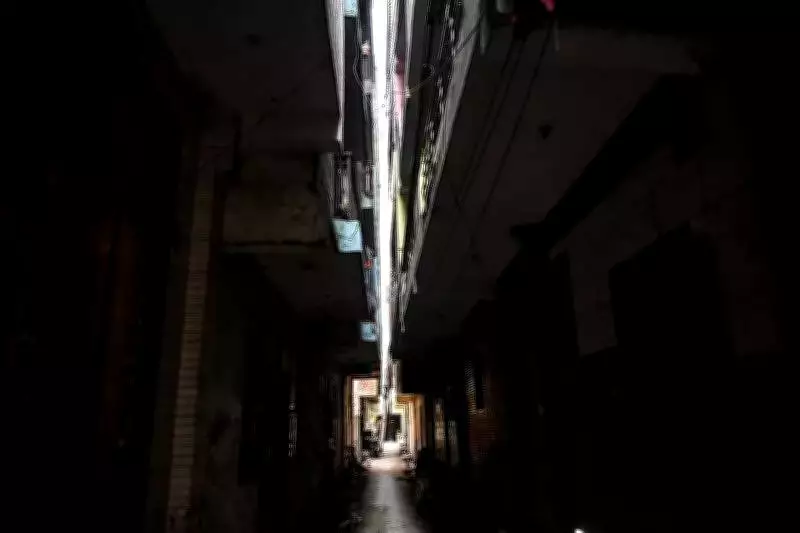
Nestled between Sector 62 in Noida and the Delhi-Meerut Expressway, Khoda Colony spans approximately 10 square kilometres and has undergone a dramatic metamorphosis over the past two decades, with acceleration notably post the Covid-19 pandemic. Once a modest peri-urban area, it has evolved into a vertical maze, largely outside the purview of formal planning regulations. Buildings routinely soar beyond legally permitted heights, often reaching six storeys, and are crammed so tightly along narrow lanes that fire engines find entry nearly impossible. The structures stand wall-to-wall, with balconies almost touching, allowing residents on opposite sides to converse effortlessly or even exchange handshakes. Below, the lanes resemble dark trenches where sunlight seldom penetrates, while overhead, a chaotic web of loose power cables criss-crosses the sky in tangled clusters.
Cheap Rents Fuel Unchecked Vertical Expansion
For thousands of workers—including delivery riders, cab drivers, factory hands, and construction labourers—dispersed across Noida, Delhi, and Ghaziabad, Khoda Colony has emerged as a highly accessible and affordable living option. Low rents, as minimal as Rs 3,000 per month for a basic room with a cooking corner and wash basin, attract these tenants, while local landowners profit from turning small plots into steady income streams. Deepak Sharma, a long-time resident since the 1980s, owns a five-storey building on a 60-square-yard plot in Azad Vihar, where each floor houses four small rooms renting for about Rs 3,500 monthly. He notes that demand remains consistently high, with rooms rarely vacant, as tenants come and go with fluctuating work opportunities.

Sharma attributes the surge in demand to the rapid development in nearby Sector 62, where an IT park and data centre brought thousands of workers to the region about a decade ago, many of whom sought accommodation in Khoda, spurring its upward growth. Not all residents are gig economy workers; some, like Dinesh Singh, a school clerk in Sector 62, are lower-income salaried employees priced out of Noida's planned sectors. Singh moved here four years ago with his family, renting a modest unit for Rs 10,000 per month, citing proximity to work and cost savings as key factors.
Informal Hostels and Fire Safety Neglect
Alongside small-scale landlords, larger buildings function as informal hostels, packing dozens of rooms across multiple floors and sometimes housing over 150 people. The building where the recent fire occurred is reported to be one such structure, owned by builders with greater financial resources and influence. These properties often operate without mandatory safety approvals, exacerbating risks during emergencies like fires. Chief Fire Officer Rahul Pal estimates that nearly 90% of structures in Khoda Colony lack fire safety clearance, with many built without approved maps from the Khoda Makanpur Nagar Palika Parishad, rendering them ineligible for fire No Objection Certificates (NOCs).
Pal highlights that Khoda is among the city's most fire-prone areas, witnessing 25-30 incidents annually, yet fire engines struggle to navigate the colony's inner lanes. Firefighters frequently must manually lay water pipelines stretching two to three kilometres to reach blaze sites, delaying response times and increasing danger.
Lax Zoning and Commercial Boom
The transformation of Khoda Colony extends beyond residential cramming to a bustling commercial strip along roads facing Sector 62 Noida and the Delhi-Meerut Expressway. Here, retail outlets, garment stores, sweet shops, dhabas, and electronics showrooms crowd the roadside, with shops typically occupying ground floors and rental rooms stacked above. Zoning rules exist largely on paper, allowing diverse businesses to operate side-by-side, from biryani outlets to mechanic workshops.

Local property dealers report that commercial buildings along main roads can command rents of Rs 2-3 lakh per month, with gyms being significant tenants paying Rs 55,000-60,000 monthly. Property values have skyrocketed, with a five-storey building on a 60-square-yard plot recently selling for about Rs 1.2 crore. This lucrative potential has ignited a relentless construction race, with debris piling up in lanes as owners add extra floors to ageing structures, often without regard for safety.
Weak Infrastructure and Changing Ownership Patterns
Deepak Joshi, president of the local residents' welfare association, points out that inadequate civic infrastructure, particularly plummeting groundwater levels to nearly 350 feet and unreliable piped supply, is subtly altering ownership dynamics. Some long-time residents, fearing complete water depletion, sell plots cheaply to builders, who then erect five- to seven-storey buildings with minimal safety considerations. For older residents like Avtar Singh in Adarsh Nagar, this vertical expansion has tangible impacts, such as blocked sunlight from neighbouring high-rises.
Population growth has surged alongside this development. While Census 2011 data recorded just under two lakh residents, local officials now estimate nearly seven lakh, with some residents believing numbers may approach 10 lakh. Enforcement has lagged, as acknowledged by Mohini Sharma, chairperson of the Khoda-Makanpur Nagar Palika Parishad, who notes that many illegal structures are built by developers with political backing, complicating regulatory efforts.
Aftermath and Community Response
In the wake of the recent fire, the residents' association submitted a memorandum to SDM Arun Dixit, urging action against illegal buildings and questioning how structures housing hundreds could be erected without approvals or fire safety clearances. Despite this, a sense of complacency persists among some long-time residents. Deepak Sharma, a landlord with three decades in the colony, reflects that many have grown accustomed to the precarious conditions, not perceiving them as major dangers.
This tragedy serves as a stark reminder of the urgent need for improved urban planning, stricter enforcement of building codes, and enhanced fire safety measures in rapidly urbanising areas like Khoda Colony, to prevent future catastrophes and ensure resident safety.