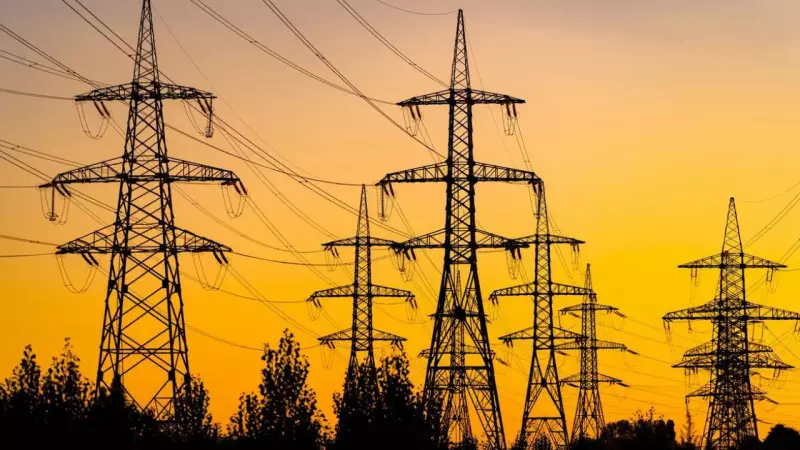
NEW DELHI: The Indian government announced on Thursday that the country's high-voltage power transmission network has achieved a significant milestone, crossing the 5 lakh circuit kilometer (ckm) mark. This development comes amid growing concerns about the grid's capacity to effectively evacuate power from renewable energy projects across the nation.
Transmission Network Expansion and Renewable Energy Goals
With India ambitiously targeting 500 gigawatt (GW) of renewable energy capacity by 2030, strengthening the high-voltage inter-state and intra-state transmission infrastructure has become critically important. A robust transmission network is essential for evacuating green energy efficiently and ensuring overall grid stability.
The milestone was reached on January 14 with the commissioning of a 765-kV transmission line in Rajasthan. This line is specifically designed for evacuating 1,100 MW of green energy from the Bhadla, Ramgarh, and Fatehgarh solar power complex located within the Rajasthan renewable energy zone.

Recent Additions and Future Expansion Plans
The network expanded by 628 ckm earlier this month in Rajasthan, pushing it past the 5 lakh ckm threshold. Since April 2014, India has added an impressive 2.1 lakh ckm to its high-voltage transmission infrastructure. Government sources have revealed plans to further expand this network to 6.5 lakh ckm by 2032.
Currently, 40,000 ckm of transmission network is under construction through inter-state transmission projects, while another 27,500 ckm of intra-state transmission projects are being implemented. These ongoing developments are expected to significantly enhance grid reliability and power evacuation capabilities across the country.
Transformation Capacity Growth
Alongside the expansion of transmission lines, transformation capacity has also seen substantial growth, reaching 1,407 gigavolt ampere (GVA). Officials project this capacity to increase to 2,345 GVA by 2032, further strengthening India's power infrastructure.
Performance Shortfalls and Current Challenges
Despite these achievements, the transmission sector has faced challenges in meeting annual targets. In the 2024-25 financial year, only 8,830 ckm of new transmission lines were commissioned against a target of 15,253 ckm, reflecting a 42% shortfall.
The current fiscal year shows similar trends, with 6,961 ckm added until December against a target of 15,382 ckm for FY26. These shortfalls highlight the implementation challenges facing transmission infrastructure development.
Power Sector Brainstorming Session in Himachal Pradesh
A senior power department official revealed that further strengthening of the transmission network is among the key issues being discussed at a two-day 'chintan shivir' (brainstorming session). This gathering of ministers and senior officials from the Union ministry, state power departments, and related public sector undertakings began on Thursday at Parwanoo in Himachal Pradesh.
Comprehensive Agenda for Discussion
The brainstorming session covers a wide range of critical power sector issues:
- The financial health of power distribution companies (discoms)
- The final draft of the Electricity Amendment Bill
- Installation of smart meters across the country
- Challenges in the generation sector
- National energy goals and security concerns
- Integration of new technologies in the power sector
Discom Financial Performance and Concerns
Recent data reveals that nearly 65 state-run and private power distribution companies posted a combined profit after tax (PAT) of ₹2,700 crore in FY25. However, officials have expressed serious concerns about ₹6.9 lakh crore of accumulated losses and approximately ₹7.2 lakh crore of outstanding debt within the discom sector.
These financial challenges, along with issues of high cross-subsidies, the need for cost-reflective tariffs, and improvements in billing and recovery efficiency, are expected to feature prominently in the discussions.

Electricity Amendment Bill Progress
Ministers and officials are also likely to discuss comments received from various stakeholders on the draft Electricity Amendment Bill. This important legislation is expected to be tabled in Parliament during the upcoming Budget session, marking a significant step in power sector reforms.
The expansion of India's transmission network represents a crucial component of the country's energy transition strategy. As the world's largest synchronous national grid continues to grow, its development remains intrinsically linked to India's renewable energy ambitions and overall economic progress.