

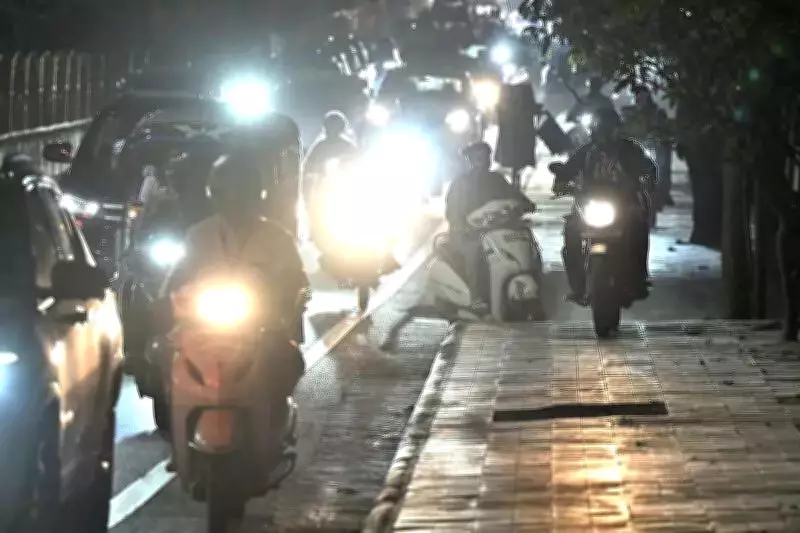
Hyderabad's Pedestrian Crisis: Footpaths Disappear Under Encroachments
In the wake of the Telangana High Court's directive to the Greater Hyderabad Municipal Corporation (GHMC) to identify and remove footpath encroachments, a comprehensive city survey reveals a stark reality: what should be safe pedestrian pathways have largely vanished, crumbled, or been systematically occupied, transforming walking into a daily hazard for hundreds of thousands of residents.
North and Eastern Zones: Pedestrians Pushed Into Traffic
Across northern and eastern Hyderabad neighborhoods, including Malkajgiri, Sainikpuri, and Dr AS Rao Nagar, pedestrians find themselves routinely forced onto busy carriageways. The limited walking space that exists is dominated by parked two-wheelers, roadside eateries, auto-rickshaw stands, and makeshift shops.
"There is a footpath on paper, not on the road," stated Geedi Charanjith Goud, a Malkajgiri resident. "It is the responsibility of people's representatives to flag the issue and of the municipal authorities to resolve it. Every morning, I walk on the main road with buses brushing past me."

The situation deteriorates significantly near commercial centers and transit hubs. In areas like ECIL, Tarnaka, and Habsiguda, footpaths have been steadily appropriated by vendors and shopfront extensions.
"We are treated as obstacles on our own footpaths," lamented V Hema Latha, a Dr AS Rao Nagar resident. "When I go to pick up my children from school, it becomes difficult to walk with vehicles moving at high speed. Street vendors, parked bikes, and shop entrances completely block the way."
Eastern Stretches: Encroachment Meets Poor Maintenance
In eastern stretches such as Uppal, the encroachment problem is compounded by severe maintenance issues. Cracked slabs, uneven tiles, and debris left behind after utility work have transformed pavements into genuine hazard zones for pedestrians.
Urban planners and activists point out that this widespread crisis reflects a long-standing systemic neglect of pedestrian infrastructure in urban planning priorities.
Western and Central Hyderabad: A Citywide Pattern
The footpath crisis extends across multiple zones. In western Hyderabad's Tolichowki, the area near Pista House has disappeared under rows of parked two-wheelers and eatery extensions.
"By evening, there is not even a single uninterrupted step you can take on the pavement," explained Sameera Khan, a local homemaker. "We walk in a line on the road and hope vehicles slow down. It's especially concerning when we are with children who may suddenly run into traffic."
Along the Rythu Bazaar corridor and beneath the PVNR Expressway, pushcarts and temporary sheds leave barely a foot-wide gap for pedestrians. Fruit vendors in these areas express their own dilemmas.
"We are not occupying space for luxury," said Ramesh, a vendor. "There is no organized vending zone for us here. Give us a proper place and we will move." He added that frequent eviction drives create uncertainty without offering sustainable alternatives.
Under the Lakdi-ka-pul Metro station, footpaths are obstructed by shop extensions, display boards, and parked autos, forcing commuters exiting the station directly into traffic lanes during peak hours.
In central city areas, pavements face similar misuse. On Minister Road in Rasoolpura, especially near car service centers, pavements transform into car-wash zones and parking bays by dusk.
"We have complained a few times because we have barely any space to walk here," said Laxmi Jadhav, a 32-year-old resident. "But the garage owners say they have no other space for servicing. We don't even know whom to complain to effectively." She noted that in Sindhi Colony as well, every inch of footpaths is occupied by roadside eateries.
The Daily Negotiation with Traffic
Santosh Mallareddi, a finance professional and regular runner and cyclist, described walking as less of a right and more of a daily negotiation with traffic.

"I start early, around 5 am, before business begins because there is absolutely no space later," he explained. "Many roads either don't have footpaths or they are broken or encroached upon. We need safer spaces for commuters on foot and on bicycles."
Systemic Issues and Selective Enforcement
Kanthi Kannan, founder of Right to Walk, highlighted that encroachment extends beyond street vendors to more affluent residents.
"Encroachment is not limited to poor street vendors; even affluent residents occupy footpaths by building watchmen's rooms or placing generators on them in areas like Banjara Hills and Jubilee Hills," Kannan stated. "Action is rarely taken against such violations. Pedestrian infrastructure must be planned based on need, not leftover budgets."
Kannan criticized foot overbridges as often prioritizing vehicle speed by pushing pedestrians out of the way, treating pedestrians as an afterthought in urban planning.
GHMC Acknowledges Challenges and Ongoing Efforts
Meanwhile, officials from the Greater Hyderabad Municipal Corporation acknowledge the significant challenge. Anti-encroachment drives, including recent operations under Operation ROPE, have cleared hundreds of structures across north Hyderabad and Secunderabad.
Plans are reportedly in place to build footpaths on roads of adequate width. "We are conducting anti-encroachment drives on a daily basis and removing illegal occupations across all zones of the city," said RV Karnan, GHMC Commissioner. "These drives will continue on a regular basis."
However, residents and activists argue that until pedestrian infrastructure is planned, built, and protected with the same priority as road expansion, walking will continue to feel unsafe across Hyderabad.
For now, across much of the city, the footpath remains Hyderabad's most contested—and most neglected—public space, with pedestrians paying the price through daily safety compromises and navigational challenges.





