

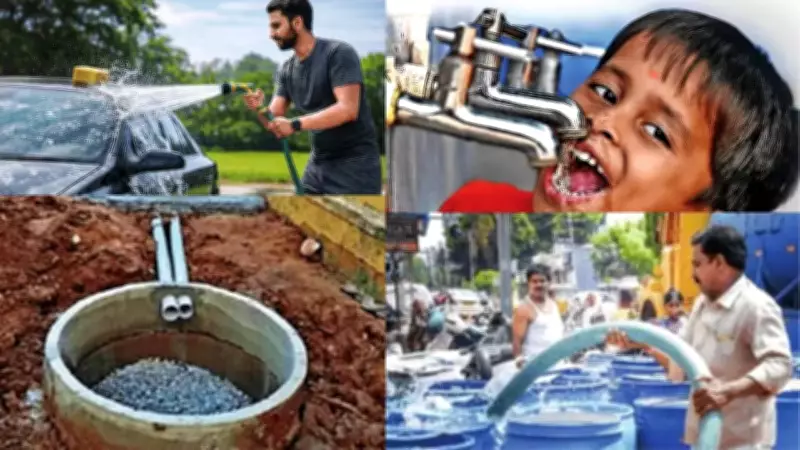
Hyderabad's Water Crisis Intensifies Amid Rapid Urban Expansion
Hyderabad's remarkable transformation into a global city over the past decade has come at a steep cost: a looming water crisis that threatens to leave its taps dry. Despite the city's geographical limits expanding from 650 square kilometers to over 2,000 square kilometers and its population nearly doubling from 70 lakh in 2012 to 1.3 crore today, the drinking water supply has remained frozen at 600 million gallons per day for more than 14 years.
Stagnant Supply Meets Soaring Demand
The last significant addition to Hyderabad's water infrastructure was in 2012, with the Krishna Phase III project adding 90 MGD. Since then, there has been zero increase in supply, even as demand has surged sharply. Currently, Hyderabad faces a shortfall of approximately 150 MGD, a gap projected to widen to over 230 MGD by 2027, when demand is expected to reach 833 MGD.
The crisis is most acute in fast-growing peripheral areas such as Kollur, Mokila, Tellapur, Nallagandla, and regions beyond Osmannagar, where real estate development has boomed but water infrastructure has failed to keep pace. Residents in these zones depend heavily on groundwater and private tankers to meet daily needs.

Groundwater Under Severe Stress
With limited piped supply, the burden has shifted alarmingly to groundwater, pushing many areas into dangerous over-exploitation. Several mandals, including Ameerpet, Khairatabad, Amberpet, Balanagar, Bachupally, and Serilingampally, are now classified as over-exploited, with extraction levels ranging from 100% to 177%. According to Central Groundwater Board norms, anything above 100% indicates usage beyond natural recharge levels.
Groundwater depths in key areas like Kukatpally, Malkajgiri, Patancheru, and Uppal have dropped to 13–17 metres as early as February. B Venkateswara Rao, a retired professor from the Centre for Water Resources at JNTUH, emphasized, "Scientifically designed rainwater harvesting systems and injection borewells are critical to replenish aquifers and stabilise groundwater levels."
Rising Dependence on Tanker Supply
The city consumed nearly 20 lakh tanker loads last year, with 3% of residents relying entirely on tanker supply. Strikingly, 90% of tanker bookings originate from 42,000 apartment complexes, predominantly in the western corridor. KM Lakshmana Rao, an expert in disaster management, warned, "Granting building permissions without ensuring water infrastructure is a serious lapse. Authorities must pause approvals until supply systems are in place."
Inadequate Rainwater Harvesting Efforts
Poor implementation of rainwater harvesting is exacerbating Hyderabad's water woes. A survey by the Hyderabad Metropolitan Water Supply and Sewerage Board revealed that dry borewells in apartment complexes are a major driver of the surge in tanker demand. The board identified over 40,000 residential complexes that regularly book more than 20 tankers monthly. Of these, 17,384 buildings had no percolation pits, while 22,825 had some form of rainwater harvesting, often inadequate or poorly maintained.
Ravi Shankar, president of the Federation of Gated Communities in Cyberabad, noted, "In the western corridor — including Kondapur, Madhapur, Gachibowli, and Nanakramguda — nearly 70% of borewells are already dry even before summer, yet communities remain hesitant, citing limited effectiveness during peak demand months."
Waste of Treated Water Amid Scarcity
While Hyderabad struggles with water scarcity, a massive volume of treated water is going to waste due to lack of demand. The city generates nearly 1,900 MLD of treated wastewater from over 50 sewage treatment plants, which could be used for gardening, construction, and other non-drinking purposes. However, uptake remains shockingly low, with less than 2% being utilized, and the rest discharged into rivers.
D Sudarshan, director of transmission at HMWSSB, explained, "To address this gap, we are now planning to channel treated water to industries, where demand is more consistent, in a bid to reduce wastage and ease pressure on water supplies." A kilolitre of treated water costs ₹20, offering a cost-effective alternative.

HMWSSB's Ambitious Plans for Augmentation
In a major push to strengthen the city's drinking water supply, HMWSSB has undertaken the Godavari drinking water supply scheme Phase II & III, estimated at ₹7,360 crore. This project aims to bring an additional 300 MGD of water to Hyderabad by 2030, addressing the needs of the rapidly growing population.
Hyderabad's water demand is projected to rise to 835 MGD by 2027 and further to 1,114 MGD by 2047, making augmentation critical. A senior HMWSSB official stated, "Under the new plan, the government will draw 20 TMC of water from the Godavari river via the Mallanna Sagar reservoir. Of this, 17.5 TMC will be used for drinking water supply, while 2.5 TMC will be allocated to revive the twin reservoirs as part of the Musi river rejuvenation project."
Crackdown on Water Misuse
Cracking down on misuse of drinking water, HMWSSB has been imposing fines up to ₹10,000 on residents found using drinking water for non-essential purposes. So far, around 10 individuals have been penalized in separate instances, including a resident in Jubilee Hills fined ₹5,000 for cleaning house floors with drinking water. The board emphasizes that treated drinking water must be used strictly for consumption, with strict action against diversions for activities like vehicle washing.
Future Initiatives and Challenges
In response to the crisis, HMWSSB has proposed constructing 50,000 rainwater harvesting pits up to the Outer Ring Road over the next five years, aiming to recharge 5–10 TMC of groundwater—more than the combined storage capacity of Himayat Sagar and Osman Sagar reservoirs. This initiative highlights the urgent need for sustainable water management practices as Hyderabad continues its rapid urban growth.





