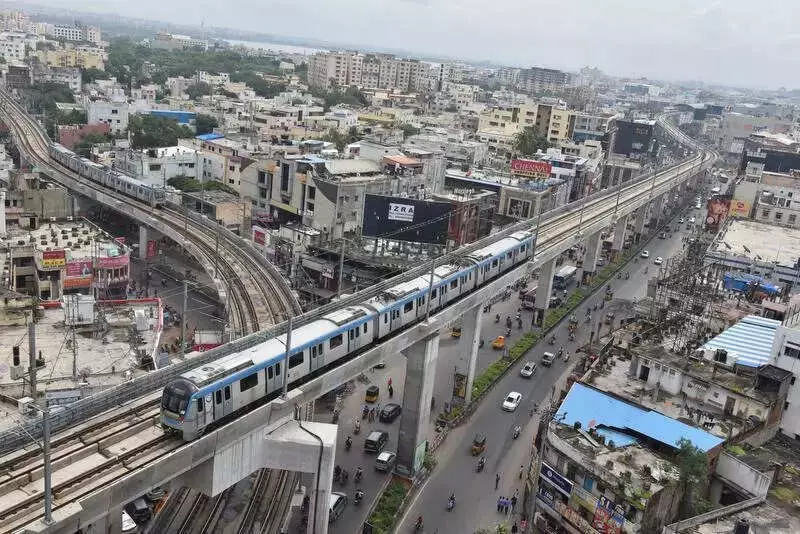
Hyderabad Metro Emerges as Key Player in India's Urban Rail Expansion
Hyderabad's rapidly expanding metro system has now secured its position among the country's largest urban rail networks, according to a comprehensive study conducted by the economic advisory council to the Prime Minister. This development comes at a crucial time when cities across India are grappling with the dual challenges of rapid urbanization and deteriorating air quality.
Metro Rail's Environmental Impact: A National Perspective
The study, titled 'Golden Decade of Infrastructure Development in India with Special Reference to Metro Rail Network,' places Hyderabad's growth within a broader discussion about the environmental benefits of metro systems. Currently, Hyderabad boasts the fifth largest operational metro network in India, spanning an impressive 69 kilometers of track that connects various parts of the bustling city.
The research highlights how metro rail can play a decisive role in cutting pollution and curbing emissions in rapidly growing urban centers. By providing a reliable alternative to road transport, metro systems significantly reduce dependence on private vehicles, which are major contributors to urban air pollution.

Delhi Metro Case Study: Quantifying the Benefits
The document references a major study on the Delhi metro that assessed changes in transport-related pollutants during its early years of operation. This analysis revealed a remarkable 34% reduction in carbon monoxide levels at a major traffic intersection, pointing to a tangible decline in emissions from road vehicles following the metro's introduction.
These findings gain particular significance when considering that urban areas account for more than 70% of global CO₂ emissions, according to World Bank observations cited in the study. Public policy experts have repeatedly argued that investments in low-carbon mass transit represent among the most effective responses to urban pollution, particularly for fast-urbanizing developing countries like India.
Global Evidence Supporting Metro Benefits
Research reviewed in the study demonstrates that metro networks can deliver substantial air-quality gains, especially in cities that start with high pollution levels. Estimates indicate that the opening of a subway system can reduce particulate matter by approximately 4% in areas surrounding city centers.
According to World Bank research from 2024, there are 192 urban areas worldwide with subway systems. Analysis of these cities showed that metro networks helped cut CO₂ emissions by about 50% within those urban areas. Collectively, this translated into an 11% reduction in global CO₂ emissions attributable to urban transportation.
The study further emphasizes that metro systems improve local air quality primarily by reducing vehicle emissions. International evidence strongly supports this conclusion. A separate study examining the Taipei metro found that its launch resulted in a 5-15% decline in carbon monoxide levels, a harmful pollutant closely linked to vehicular traffic.
Hyderabad's Position in India's Metro Landscape
Hyderabad's expanding metro system now stands as a testament to how urban rail infrastructure can transform transportation in growing cities. The 69-kilometer network not only provides efficient connectivity but also contributes to the city's environmental sustainability goals.
The economic advisory council's study places Hyderabad's metro development within the context of India's broader infrastructure push, highlighting how such projects serve multiple purposes beyond mere transportation. They represent strategic investments in public health, environmental protection, and sustainable urban development.
As cities continue to expand across India, the Hyderabad metro example offers valuable insights into how urban rail systems can address the interconnected challenges of transportation efficiency, air quality improvement, and emission reduction simultaneously.