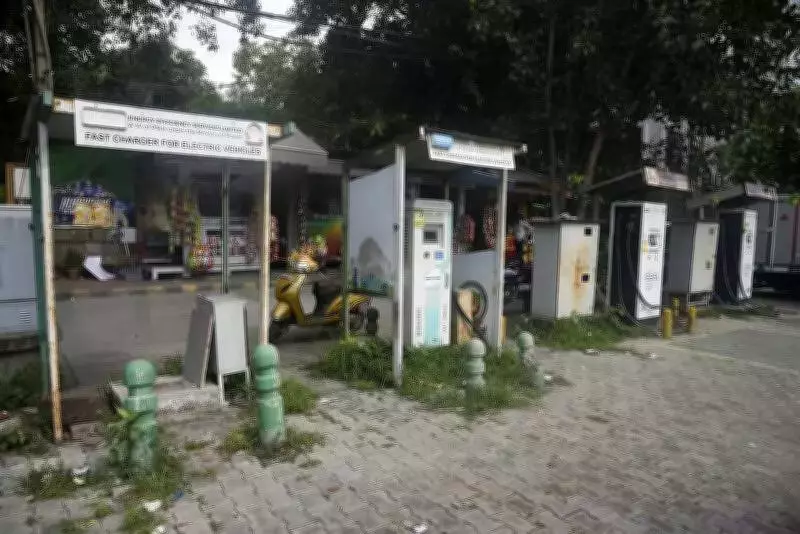
Delhi Dominates Public EV Charging Consumption Despite Lower Vehicle Count
New Delhi has established itself as India's primary consumer of electricity at public charging stations for electric vehicles, a surprising development given that Uttar Pradesh actually possesses the highest number of registered EVs nationwide. Between April and November 2025, the capital city consumed nearly 240 million units of electricity at these public charging points, representing approximately one-fourth of the total 993 million units utilized across the country for EV charging during this period.
National EV Registration Landscape
According to the transport ministry's Vahan dashboard, India currently has approximately 80 lakh registered electric vehicles, including pure EVs and battery-operated vehicles. Delhi accounts for just 4.8 lakh of these vehicles, or about 6% of the national total. In contrast, Uttar Pradesh leads with 15.2 lakh electric vehicles, followed by Maharashtra with 9.2 lakh and Karnataka with 7.2 lakh registrations.
State-by-State Charging Consumption Analysis
The Central Electricity Authority's latest EV charging station power consumption report reveals significant disparities between vehicle ownership and charging usage. While Delhi consumed 240 million units (24.2% of the national total), Maharashtra followed with 227 million units (22.9%), Karnataka with 138 million units (13.9%), and Uttar Pradesh with 131 million units (13.2%). This data indicates that Delhi's public charging infrastructure is experiencing substantially higher utilization per vehicle compared to other states.

Government Push and Market Growth
The government's concerted efforts to promote electric vehicle adoption as part of its environmental sustainability agenda and net-zero emissions target by 2070 have yielded remarkable results. Total EV sales in India surpassed 2.3 million units in 2025, capturing nearly 8% of all new vehicle registrations. This growth has been particularly strong across two-wheeler, three-wheeler, and passenger vehicle segments, reflecting broadening consumer acceptance.
Rapid Consumption Growth and Infrastructure Challenges
With the expanding EV fleet, monthly electricity consumption at public charging stations increased by nearly 33% between April and November 2025, rising from 108 million units to 143 million units. Year-over-year growth has been even more dramatic, with consumption during the April-November period increasing by approximately 52% from 515 million units in 2024 to 993 million units in 2025.
Despite this heavy usage, Delhi faces a significant infrastructure deficit. According to the action plan submitted to the Commission for Air Quality Management, the city has only 8,998 operational public charging points against a requirement of 36,177, creating a substantial gap that could hinder further EV adoption.
Beyond Public Charging Stations
The CEA report also highlights substantial growth in electricity consumption at non-public charging points, including private home chargers, workplace charging facilities, and captive charging stations. While the authority requested segregated data from power distribution companies for both public and non-public charging infrastructure, only a limited number complied with this request, indicating data collection challenges in the rapidly evolving EV ecosystem.
Regional Consumption Patterns
In November 2025, specific regional consumption patterns emerged, with BSES Rajdhani (serving south and west Delhi) recording 3.5 million units of EV charging consumption, followed by BSES Yamuna (east and northeast Delhi) with 2.7 million units, and Paschimanchal Vidyut Vitran (western Uttar Pradesh) with 2.5 million units. These figures demonstrate concentrated usage in urban centers and highlight the evolving geography of India's electric vehicle charging landscape.