

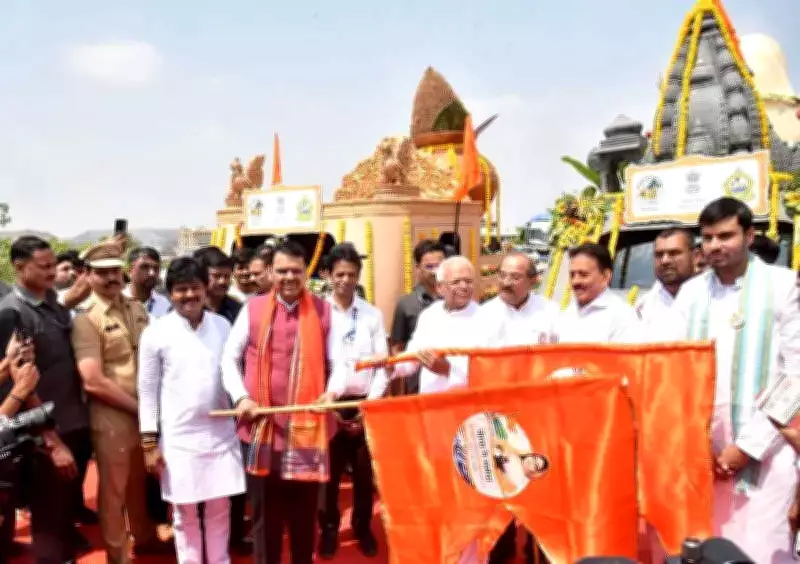
Chief Minister Devendra Fadnavis and Deputy Chief Minister Eknath Shinde on Saturday launched the 'Goda to Narmada Punyashlok Ahilyadevi Holkar Jal Yatra 2026' on the occasion of Ahilyabai Holkar's 300th birth anniversary. The yatra aims to transform Maharashtra into a drought-free state through public awareness and water-grid projects.
Launch from Trimbakeshwar
Launching the yatra from Trimbakeshwar in Nashik district, CM Fadnavis said, "Drawing lessons from Ahilyabai Holkar's measures for water conservation, the state government has decided to adopt them and implement river-linking projects to ensure the state is drought-free."
The CM flagged off the Goda-Narmada yatra from Trimbakeshwar in Nashik, while Deputy CM Eknath Shinde launched it from Chondi in Ahilyanagar, the birthplace of Ahilyabai Holkar. Both leaders will meet in Shirdi on Sunday.

Route and Significance
During the yatra, urns filled with water from 30 rivers across the state will join the procession. The journey will proceed to Ghrushneshwar Temple in Chhatrapati Sambhajinagar the next day, then to Dhule, and culminate at Maheshwar in Madhya Pradesh.
Fadnavis further stated that during the Kumbh Mela, the state plans to convert the Godavari river into a clean water body. "We will have a clean Godavari flowing all times of the year in Trimbakeshwar in the interest of pilgrims coming here round the year. The government has also decided to rejuvenate the wells and step wells created by Ahilyabai Holkar during her time," he added.
Deputy CM's Remarks
During a similar programme at Chondi, Deputy CM Shinde described the journey as more than geographical, calling it an emotional and spiritual movement. "If Chhatrapati Shivaji Maharaj lit the flame of Hindavi Swarajya, Punyashlok Ahilyadevi Holkar expanded it through her work," Shinde said.
He noted that the government has approved 223 irrigation projects worth Rs 4.25 lakh crore over four years to bring 32 lakh hectares under irrigation.
Conclusion of the Yatra
The journey will conclude on April 29 in Maheshwar, Madhya Pradesh, the riverside town that was once the capital of the Holkar Administration. Ahilyabai Holkar had carved out a separate stream allowing water for daily use to ensure the main river remains clean.






