

Chandigarh Municipal Corporation Prepares for Fresh Survey of Major Waste Generators
The Chandigarh Municipal Corporation (MC) is gearing up to conduct a comprehensive new survey to identify significant waste-generating establishments across the city. This initiative comes as the newly implemented Solid Waste Management (SWM) Rules-2026 take effect from April 1, substantially broadening the definition of bulk waste generators (BWGs). Civic officials confirmed these developments on Monday, highlighting the city's proactive approach to enhanced waste management protocols.
Awaiting Central Guidelines Before Survey Commencement
Municipal authorities have indicated they are currently awaiting detailed instructions and specific guidelines from the central government before launching the extensive identification exercise. "We anticipate receiving the official directions from the central government within the coming days," explained an MC official. "Once these revised norms and parameters are provided, we will immediately proceed with the survey according to the updated regulatory framework."
Current Landscape of Bulk Waste Generators in Chandigarh
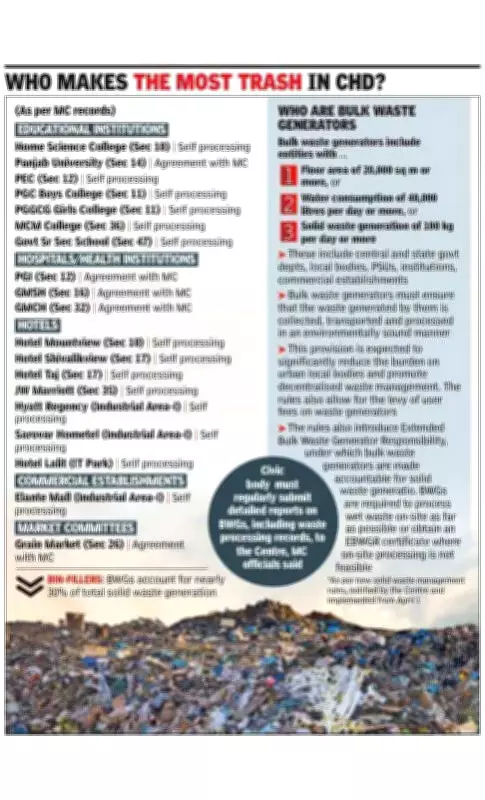
Presently, Chandigarh has officially identified 19 establishments as bulk waste generators. This distinguished list includes prominent educational institutions such as Panjab University (PU) and Punjab Engineering College (PEC), major healthcare facilities including the Postgraduate Institute of Medical Education and Research (PGI), commercial centers like Elante Mall, luxury hotels such as Taj, Hyatt Regency and JW Marriott, several prominent colleges, and the bustling grain market located in Sector 26.

Among these 19 BWGs, five establishments have entered into formal agreements with the Municipal Corporation for processing their accumulated waste. The remaining fourteen entities have independently installed their own waste-processing systems within their premises, operating in compliance with existing SWM guidelines and regulations.
Extended Producer Responsibility Framework Implementation
In a significant parallel development, the Chandigarh Municipal Corporation has officially registered itself with the Central Pollution Control Board (CPCB) under the Extended Producer Responsibility (EPR) framework. This registration has become a mandatory requirement under the newly notified SWM Rules-2026, representing a crucial component of the updated waste management ecosystem.
"Among the current 19 bulk waste generators, five specific institutions have signed formal memoranda of understanding with the Municipal Corporation," detailed a senior MC official. "These include Government Multi-Speciality Hospital (GMSH) in Sector 16, the Grain Market in Sector 26, Panjab University, PGI, and Government Medical College and Hospital (GMCH) in Sector 32. These agreements establish waste processing arrangements on a payment basis."
The official further explained the rationale behind these agreements: "Given the substantial scale of waste generation at these major institutions, they expressed practical limitations in establishing independent processing systems and machinery. Consequently, the Municipal Corporation entered into these MoUs, and their daily waste is now systematically transported to the MC's central processing plant for appropriate treatment and disposal."
Monitoring and Compliance Mechanisms
The remaining fourteen bulk waste generators continue to process their waste independently while remaining under the direct monitoring and supervision of the Municipal Corporation. This oversight ensures compliance with established standards and maintains accountability within the waste management framework.
Officials emphasized that effective waste processing by bulk waste generators represents a critical evaluation parameter under the central government's Swachh Survekshan program. This assessment occurs alongside other important benchmarks established under the comprehensive SWM framework.

"The Municipal Corporation must regularly submit detailed reports concerning bulk waste generators to the central government," noted a senior officer. "These reports include comprehensive waste processing records and operational data. Dedicated logbooks are meticulously maintained for all BWGs, and sanitation department teams conduct frequent, unannounced inspections and checks. These documented records form an essential component of the annual Swachh Survekshan assessment, directly impacting the city's cleanliness rankings and evaluations."
The upcoming survey represents a strategic step toward aligning Chandigarh's waste management practices with the enhanced requirements of the SWM Rules-2026, potentially identifying additional establishments that now fall under the expanded definition of bulk waste generators. This proactive approach demonstrates the city's commitment to sustainable urban development and environmental stewardship.





