Adani Group Secures Major Mumbai River Restoration Project
Following its successful bid for the Dharavi slum redevelopment, the Adani Group has now emerged as the key player in another significant infrastructure project in Mumbai. A Special Purpose Vehicle (SPV) led by Adani Transport, in partnership with Ashoka Buildcon Limited and Akshaya Infraproject Pvt Ltd, has been selected as the lowest bidder for the Rs 1,700-crore Mithi River Rejuvenation Project (Package 3).
Project Scope and Critical Flood Control Measures
The ambitious project focuses on a crucial 18-kilometer stretch from the CST bridge at Kurla to Mahim, where the river ultimately meets the Arabian Sea. The comprehensive plan includes several vital components designed to address Mumbai's persistent flooding issues.
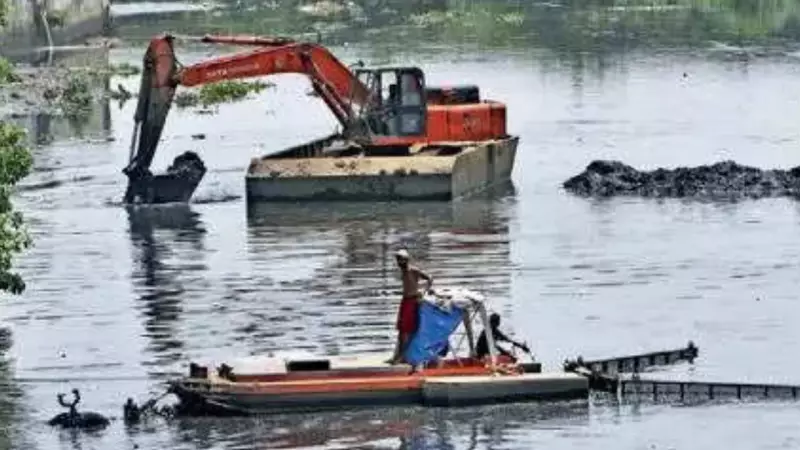
The key elements include installing gate-pump assemblies at 18 outfalls, constructing a major sewerage pumping station likely at Machhimar Colony near Mahim, and creating a dry-weather flow interceptor to redirect sewage to the Dharavi treatment plant. Additional work involves building sewer lines, service roads, and retaining walls along the riverbanks.

A civic official explained the mechanism: "During heavy monsoon rains, the gate-pump assemblies will prevent sea water from entering the river while simultaneously pumping out accumulated rainwater back into the sea." This approach directly addresses one of Mumbai's most pressing monsoon challenges.
Controversy and Political Backlash
The project award has sparked political controversy, with the Congress party leveling serious allegations against the ruling government. Sachin Sawant, secretary of the All India Congress Committee, took to social media platform X to voice his concerns.
Sawant claimed he had raised allegations of corruption in the tender process approximately 1.5 months ago, stating that the tender violated Central Vigilance Commission guidelines. He alleged that the tender was repeatedly postponed to ensure the contract would be awarded to Adani, whom he described as "an industrialist close to the BJP."
The political statement from Congress summarized their position clearly: "The current government is not of the Mahayuti, but of Adani."
Project History and Technical Details
The current initiative stems from recommendations made by consultant Frischmann Prabhu, whom the Brihanmumbai Municipal Corporation (BMC) appointed in 2017 to propose both short and long-term pollution control measures for the Mithi River. After conducting extensive surveys, the consultant suggested four project packages aimed at diverting approximately 285 million liters per day (MLD) of dry-weather discharge from the Mithi into Mumbai's municipal sewer system.
Interestingly, the bidding process saw the SPV initially quote 7.7% above the base cost, which the BMC successfully negotiated down to 7.1%. However, this still means the municipal corporation will pay more than its original estimate. Other notable bidders included Afcons and Hindustan Construction Company Limited (HCC).
Implementation Timeline and Previous Efforts
This package represents one of the final phases in the long-running Mithi River rejuvenation effort. With the proposal now forwarded for administrative approval, work is expected to accelerate next year, pending necessary environmental clearances.
The project follows a "design, build, and operate" model, meaning the contractor will operate and maintain the infrastructure for ten years after construction completion. The construction phase itself is scheduled to last 48 months, excluding monsoon periods.
Notably, the BMC had initially planned to include a promenade in this phase but later dropped the feature due to significant cost escalation concerns.
To date, the BMC and Mumbai Metropolitan Region Development Authority (MMRDA) have already spent over Rs 2,000 crores on restoring the Mithi River, yet the vital waterway's complete restoration remains unfinished. Visible improvements are currently evident mainly at the river's head near Filterpada, where slums have been cleared to make way for retaining walls and service roads that enable cleaning machines to access the river.

A new sewer line has been installed to channel sewage water to a treatment plant at Powai, where the water undergoes purification before being discharged back upstream, marking some progress in the ongoing rehabilitation of Mumbai's crucial river system.