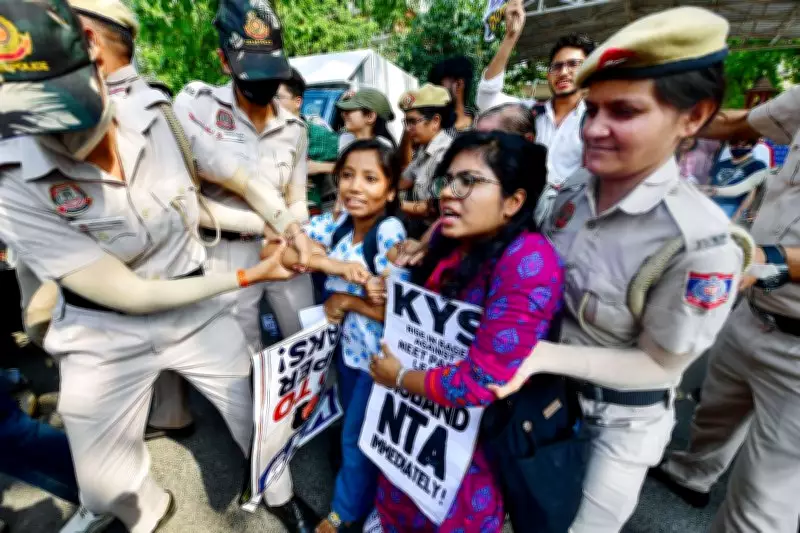
A nationwide survey conducted by Team Cvoter on May 28 has revealed that public confidence in India's education system has been severely shaken following the NEET-UG 2026 and CBSE controversies. The fallout has moved beyond examination centres and courtrooms into a broader debate about trust and governance.
Key Findings of the Survey
The survey highlights striking numbers: 66.2 per cent of respondents believe Union Education Minister Dharmendra Pradhan should resign over the handling of the controversies. Additionally, more than six in ten respondents favour the dismantling of the National Testing Agency (NTA). These figures point to a deeper concern regarding the fairness and transparency of the country's examination system.
Loss of Trust in the System
For decades, competitive examinations have been seen as a gateway for merit-based access to higher education and professional careers. Millions of students invest years of preparation, often at considerable financial and emotional cost, trusting that the process is impartial. However, the survey suggests that this confidence has been eroded. More than half of respondents said they have no trust in the education system and the government's ability to be fair to students. Another significant group reported gradually losing trust. Taken together, nearly three-fourths of those surveyed either distrust the system or say their faith is weakening.

Public institutions can withstand administrative errors, but a loss of confidence in the institution itself is harder to repair. The survey indicates that concerns surrounding NEET and the CBSE's On-Screen Marking (OSM) system are increasingly viewed not as isolated incidents but as evidence of broader weaknesses in educational governance.
Deterioration in Governance
More than 70 per cent of respondents said governance in educational matters has deteriorated over the past five years. Nearly the same proportion stated that the Class 12 board examination system requires major reforms. These numbers suggest that dissatisfaction is no longer confined to the management of one examination or one academic year. Instead, respondents appear to be questioning the wider framework through which examinations are conducted, evaluated, and regulated.
Demands for Accountability
As concerns about governance have grown, so have demands for accountability. When asked whether Education Minister Dharmendra Pradhan should resign, nearly two-thirds answered in the affirmative. However, the survey also shows that public frustration is not directed at a single office-holder alone. Respondents distributed responsibility across testing agencies, government institutions, and ministerial leadership. A significant number indicated that examination failures should be viewed as a failure across the chain of decision-making rather than the result of one individual's actions.
Support for Structural Reform
This sentiment is most visible in attitudes towards the NTA. More than six in ten respondents said the agency should be dismantled and the country should return to the earlier system of conducting entrance examinations. This finding suggests a demand for structural reform rather than limited corrective measures.
Political Implications
The most politically significant aspect of the survey may be where these demands are coming from. Criticism from opposition supporters would not be unusual, but the survey indicates that dissatisfaction has spread into sections of the ruling alliance's own support base. Among respondents who identified themselves as NDA voters in the 2024 Lok Sabha elections, 58.2 per cent supported dismantling the NTA. The same proportion said that Pradhan should resign. A majority also said educational governance has worsened.
These numbers reflect that concerns over examinations are cutting across traditional political divides. Throughout the survey, criticism emerged not only from non-NDA respondents but also from substantial sections of NDA supporters. On questions relating to governance, accountability, and reform, the gap between the two groups was often narrower than expected in a politically polarised environment.

Potential Electoral Impact
The findings become more significant when viewed alongside respondents' assessment of the possible political consequences. More than seven in ten respondents said students affected by NEET and CBSE-related issues could alter their voting preferences in future elections. Notably, this sentiment was marginally stronger among NDA voters than among non-NDA voters. The survey does not establish that educational controversies will translate into electoral outcomes, but it reveals that many respondents increasingly view examination-related issues through the lens of governance and public accountability.
Broader Crisis of Confidence
The survey reveals four interconnected trends: weakening trust in the fairness of examinations, growing dissatisfaction with educational governance, visible discontent even within the ruling alliance's voter base, and rising support for structural reforms rather than incremental adjustments. Viewed separately, each finding raises difficult questions, but together they point towards a broader crisis of confidence. For many respondents, the issue is no longer whether one examination was mishandled or one controversy adequately addressed. The question increasingly appears to be whether the system itself still commands the trust on which its legitimacy depends.
Survey Data Highlights
- Students affected by NEET/CBSE issues may change future voting choices: 71.7%
- Class 12 board examination system needs major reforms: 70.6%
- Educational governance has deteriorated: 70.2%
- Want Dharmendra Pradhan to resign: 66.2%
- Want NTA dismantled: 60.6%
- Have no trust in fairness of the system: 51.7%