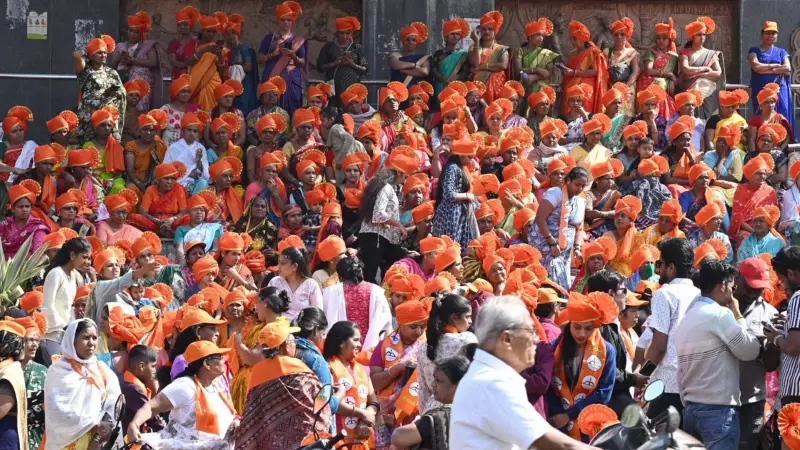
As the battle for control of the Pune Municipal Corporation (PMC) intensifies, a significant trend is emerging: the very leaders tasked with steering their parties' citywide campaigns are becoming consumed by their own ward-level contests. This focus on hyper-local battles is limiting their capacity to provide overarching strategic leadership across Pune's political landscape.
Leaders Divided Between City and Constituency
The Bharatiya Janata Party (BJP), which ruled the PMC in the previous five-year term, is pulling out all stops to regain its dominance. While the party's campaign is formally led by Union Minister of State Murlidhar Mohol, the BJP is heavily reliant on Chief Minister Devendra Fadnavis, other state ministers, and local legislators to drive its civic election campaign. Notably, the party's Pune city chief, Dhiraj Ghate, is contesting from the Navi Peth-Parvati ward, the same seat he held from 2017 to 2022, demanding his concentrated attention.
The Nationalist Congress Party (NCP) scenario is shaped by its recent split. Despite the vertical division engineered by Deputy Chief Minister Ajit Pawar, the two factions—one led by Ajit Pawar and the other by Sharad Pawar—have formed a pre-poll alliance for the PMC elections. Ajit Pawar himself is leading the campaign for this alliance. However, the city NCP chief, Subhash Jagtap, is deeply engaged in his contest from the Sahakarnagar-Padmavati ward, aiming to regain voter trust after a loss in the previous civic polls.

Alliance Dynamics and Absentee Leadership
The Congress party's Pune city chief, Arvind Shinde, is also in the electoral fray, contesting from the Pune Station-Jay Jawannagar ward, which he has represented for a long time. Consequently, the Congress lacks a single leader conducting unified campaigns across the city. Instead, state-level figures like Maharashtra Congress chief Harshvardhan Sapkal, former Chief Minister Prithviraj Chavan, and minister Satej Patil are campaigning for individual candidates.
The Shiv Sena's split four years ago has created two distinct entities in Pune: the Eknath Shinde-led Shiv Sena and the Uddhav Thackeray-led Shiv Sena (UBT). The Shinde faction's city unit is headed by former corporator Nana Bhangire, who is contesting from the Mohammadwadi-Undri ward. With no prominent local leader free for pan-city campaigning, the party is depending on rallies by Deputy Chief Minister Eknath Shinde and state minister Uday Samant.
On the other side, city Shiv Sena (UBT) chief Sanjay More is contesting from the Raviwar Peth-Nana Peth ward, hoping for his first election to the civic body. The party's Pune campaign is led by former minister Sachin Ahir, whose attention is divided between Pune and the simultaneous Brihanmumbai Municipal Corporation (BMC) elections in Mumbai. The Shiv Sena (UBT), allied with the Congress, has also partnered with the Raj Thackeray-led Maharashtra Navnirman Sena (MNS) for these polls. The city MNS chief, Sainath Babar, is fighting to retain the Kondhwa Khurd-Kausar Baug ward he held in the last term.
Strategic Implications for Pune's Political Future
This preoccupation of city chiefs with their own wards has several consequences. It often leads to a fragmented campaign strategy where the broader vision for Pune's urban governance—covering issues like infrastructure, waste management, and water supply—takes a backseat to ward-specific promises and populist measures. The reliance on state-level leaders to fill the leadership vacuum indicates a centralization of campaign strategy, potentially disconnecting it from local grassroots issues.
Furthermore, the alliance equations, such as the one between the NCP factions and the Shiv Sena (UBT)-Congress-MNS combine, add another layer of complexity. While these alliances are forged for electoral arithmetic, the ground-level coordination can be challenging when the designated local captains are primarily focused on securing their own political survival. The outcome of these PMC elections will not only determine the civic administration for the next five years but also set the tone for the larger political realignments in Maharashtra, with Pune being a critical urban bastion.