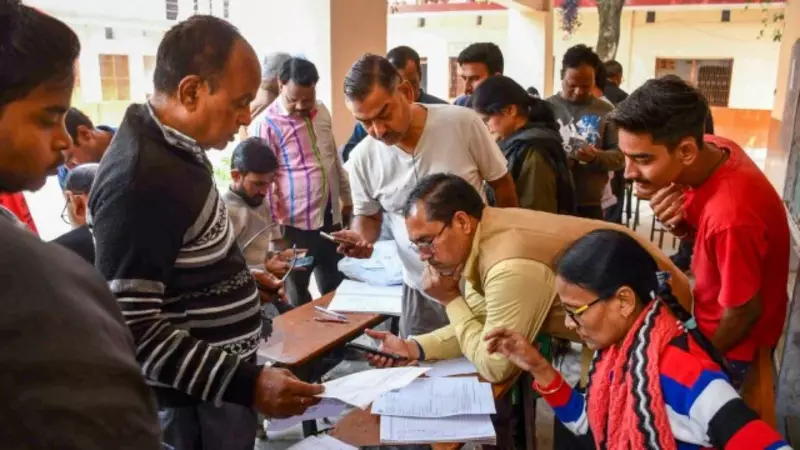
The Supreme Court of India has indicated that the Election Commission can adopt any procedure for the Special Intensive Revision (SIR) of electoral rolls, provided it is fair and transparent. The observation came during a hearing on Thursday, November 28, 2024, where the court addressed challenges to the statutory backing of the SIR process.
Court's Stance on Procedure and Transparency
Presiding over a two-judge bench, Chief Justice of India Surya Kant clarified the court's position. He stated that the SIR is not a routine update but a special survey. "Unless the rule or the statute itself contemplates a procedure to be followed, any process which should be fair enough and transparent... can be adopted by the Commission," the CJI remarked. The bench, which also included Justice Joymalya Bagchi, will resume hearings on this matter on December 2.
Legal Challenge from PUCL and Political Parties
The arguments were presented by Senior Advocate A M Singhvi, who appeared for the People's Union for Civil Liberties (PUCL) and seven political parties. Singhvi contested the EC's power to conduct the SIR, arguing that Parliament holds the authority under Article 327 of the Constitution to make laws regarding elections, including the preparation of electoral rolls.

He emphasized that the Representation of the People Act, 1950 specifies the use of certain forms (4, 6, 7) and does not authorize new forms created by the Commission. "You cannot allow your supposed non-existent executive power to operate in the interstices where parliamentary law exists," Singhvi asserted, calling the SIR a "substantive change" that can only be enacted by the legislature, not the Election Commission.
Concerns Over Practical Implementation
Senior Advocate Kapil Sibal, representing the states of West Bengal and Kerala, raised practical concerns about the SIR's implementation. He pointed out the difficulties citizens might face in providing documentary proof, such as for a woman who has married and moved, requiring her to produce an old electoral roll from 2003.
Sibal argued that the fundamental issue lies in whether a Booth Level Officer (BLO), often a school teacher, is equipped to determine citizenship. He stated that the procedural requirements are "per se unreasonable" and could lead to the exclusion of lakhs of people from electoral rolls and consequent benefits.
In response, Justice Bagchi noted that the BLO's role, as per the rules, is to check if a person's name or their parents' names appear on the 2003 roll for a prima facie verification, not to determine citizenship. The court clarified it is examining whether the EC's notice is ultra vires (beyond its powers) under the existing legal framework.