Gujarat's Voter Lists Undergo Quiet Transformation Due to Migration and Ageing
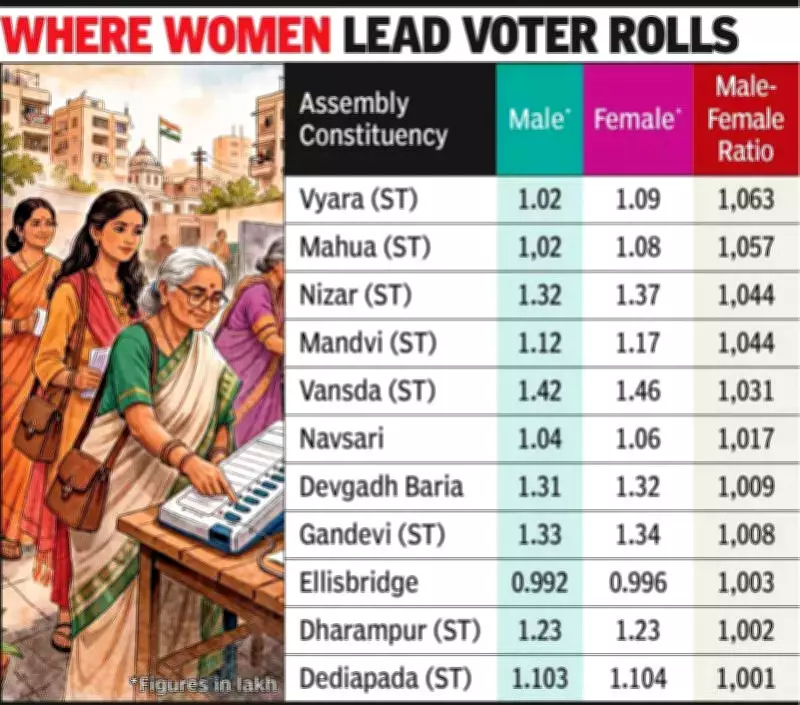
In a significant demographic shift, migration, ageing populations, and neighbourhood dynamics are subtly reshaping voter lists across parts of Gujarat. According to the final voters' list released by the Election Commission after a nearly three-and-a-half-month Special Intensive Revision (SIR) exercise, 11 out of 182 assembly constituencies in the state now boast more women voters than men. This marks a reversal of the typical electoral gender pattern, highlighting evolving social and economic trends.
Constituencies with Higher Female Voter Ratios
Most of these constituencies are Scheduled Tribe (ST) seats located in the southern districts of Gujarat, where relatively stable populations and lower levels of male out-migration contribute to a more balanced voter base, as noted by election officials. However, two non-tribal, urban constituencies—Ellisbridge and Navsari—also reflect this demographic edge for women. The list of constituencies with over 1,000 women voters per 1,000 men includes:
- Vyara (ST) with a ratio of 1,063
- Mahuva (ST) at 1,057
- Nizar (ST) and Mandvi (ST) at 1,044 each
- Vansda (ST) at 1,031
- Navsari at 1,017
- Devgadh Baria at 1,009
- Gandevi (ST) at 1,008
- Ellisbridge at 1,003
- Dharampur (ST) at 1,002
- Dediapada at 1,001
Industrial and Migration-Heavy Areas Show Weaker Gender Balances
In contrast, several industrial and migration-heavy constituencies report weaker gender balances. For instance, Karanj in Surat has a ratio of 846 women per 1,000 men, while Rapar stands at 871, Limbayat and Dhandhuka at 874 each, and Udhna at 878. Officials attribute these imbalances largely to labour-driven migration, where men relocate for work and remain enrolled in local electoral rolls while their families stay behind or are registered elsewhere. This phenomenon is particularly evident in Surat, where constituencies like Karanj, Limbayat, Udhna, Varachha Road, and Katargam reflect the impact of industrial growth and migrant labour markets.

Urban Anomalies: Ellisbridge and Navsari
Within Ahmedabad, Ellisbridge stands out against the broader urban trend. District officials, after finalising city-level data, examined neighbourhood patterns to understand the constituency's higher share of women voters. They pointed to major slum clusters, such as Gulbai Tekra, where women voters are more numerous, and parts of Navrangpura ward, where women voters—particularly senior citizens—outnumber men in several localities. The Paldi ward, which falls within Ellisbridge, also contributes to this higher female voter share. Officials suggested multiple factors at play, including a higher number of youths settled in other countries or states due to overseas migration and outstation employment, which alters the visible voter base.
Navsari, the other non-tribal constituency among the 11, was described as having multiple contributing factors. These include pockets with NRI-dominated households and areas reflecting the demographic stability seen in parts of the southern belt. While not an ST seat, officials noted that its local dynamics overlap with trends observed in regions where family-based residence is more common and migration levels are lower.
Broader Context and State-Level Concerns
The constituency-level voter data emerges amid wider concerns about gender imbalance in Gujarat. According to the Centre's report, 'Vital Statistics of India based on the Civil Registration System 2021', Gujarat recorded a sex ratio at birth of 909 girls per 1,000 boys. This places Gujarat among the most skewed states on this indicator, with a ratio lower than most of the country and only marginally better than Bihar (908), Rajasthan (905), and Assam (863). State figures show the sex ratio at birth was 898 in 2017, 897 in 2018, 901 in 2019, 909 in 2020, and remained at 909 in 2021, indicating persistent challenges.

A senior official highlighted that migration streams from Saurashtra also shape urban voter demographics. "Saurashtra and North Gujarat have a skewed sex ratio, which could be contributing to the low ratios in Surat and Ahmedabad, where a large migrant population from the region lives," the official said. Similar patterns were observed in Ahmedabad's industrial zones such as Vatva, Nikol, and Amraiwadi, where migrant-heavy settlements influence the composition of electoral rolls.
This demographic reshaping underscores the complex interplay of migration, ageing, and local dynamics in Gujarat's electoral landscape, with implications for political strategies and social policies in the state.