Election Commission to Publish Kolkata Voter Discrepancy List Affecting 1.5 Crore Electors
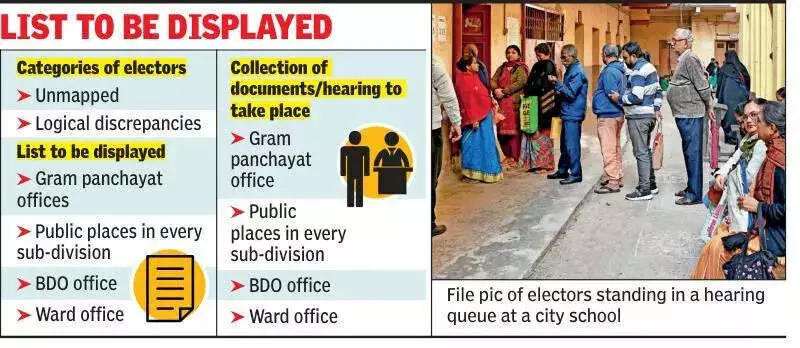
The Election Commission (EC) is poised to release a comprehensive list this Saturday detailing all voters in Kolkata who are either unmapped or have logical discrepancies in their records. This move comes as part of the ongoing Special Summary Revision (SIR) of the electoral roll, aimed at ensuring accuracy and transparency in the voter database.
Scale of Discrepancies and Impact on Voters
The list is expected to include approximately 1.5 crore voters, which is about 26 lakh fewer than the initial estimate of 1.7 crore. This reduction stems from recent corrections, but the breakdown reveals significant challenges: around 32 lakh voters are unmapped, while 1.4 crore have logical discrepancies in their enumeration forms. As a result, SIR queues are likely to be longer, as a substantial number of electors will need to participate in hearings to resolve these issues.
EC's Efforts to Resolve Minor Issues
Earlier, the EC had indicated that about 42 lakh individuals on the logical discrepancy list had minor issues that were resolved. However, on Saturday, EC officers clarified that this figure is actually around 26 lakh, suggesting that an additional 16 lakh people must attend hearings to address their discrepancies. This adjustment highlights the dynamic nature of the voter verification process.

In a bid to streamline corrections, the EC has instructed that minor spelling mistakes in names will be corrected by Booth Level Officers (BLOs) without requiring hearings. Already, BLOs have corrected such errors for about 20 lakh electors after collecting necessary documents, and these individuals are likely to be exempted from the hearing process. Notably, hearing notices that were already generated for some cases have been ordered not to be delivered, reflecting the EC's adaptive approach.
Uncertainties in List Preparation and Public Display
As of Friday evening, the EC software tasked with preparing the voter list had not completed its work, creating uncertainty regarding the exact timing and locations for public display of the lists. This delay underscores the technical complexities involved in managing such a large-scale electoral exercise.
Hearings and Compliance with Supreme Court Order
Following the January 19 order of the apex court, the EC will call all electors with logical discrepancies to hearings. A senior EC official explained, "Primarily, we identified around 1.4 crore electors with logical discrepancies. After uploading documents in the backend, this reduced to about 1.1 crore on Friday morning. These 1.1 crore people will be called to hearings to submit EC-notified documents."
An EC official elaborated on the legal basis, stating, "The Supreme Court order mandates that affected persons be given an opportunity to submit documents and be heard, either in person or through authorized representatives. Accordingly, the Commission will call all logical discrepancy cases to hearings to comply with this directive."
Document Submission and Final Electoral Roll Inclusion
The EC has deputed roll observers for the SIR exercise in Bengal to review documents submitted during hearings. They are tasked with ensuring that no name is included in the final electoral roll without the necessary EC-notified documents. EC sources emphasized, "If a person does not submit any of the required documents in the hearing, their name will not appear on the final list. In such cases, individuals must submit Form 6 along with requisite documents to get enrolled as electors."
Venues for Hearings and State Government Coordination
To facilitate the process, the EC has informed the state government that SIR proceedings, including document collection and hearings, will be conducted at multiple venues. These include Gram Panchayat Bhawans, public places in every subdivision, BDO offices, and ward offices in urban areas, ensuring accessibility for voters across Kolkata.

This initiative by the Election Commission represents a critical step in refining the electoral roll, with significant implications for voter participation and democratic integrity in the upcoming elections.