Nationwide Electoral Roll Revision Puts Booth-Level Officers Under Immense Pressure
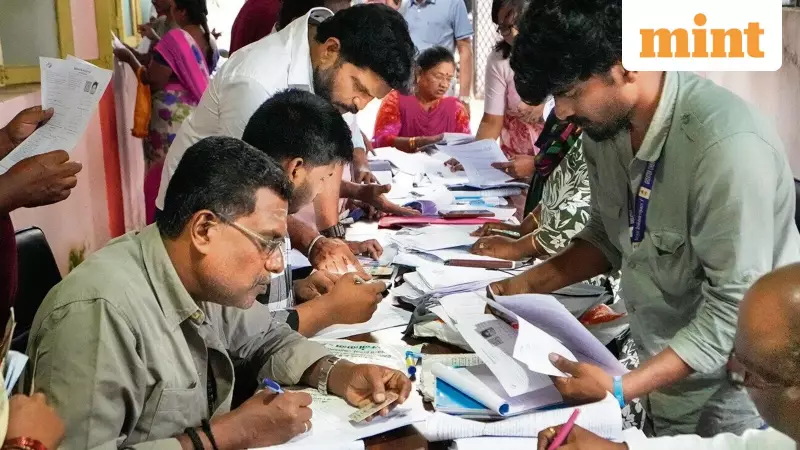
The ongoing Special Intensive Revision (SIR) of electoral rolls across India has placed booth-level officers (BLOs) at the center of a growing controversy. These grassroots election officials, particularly in opposition-ruled states like West Bengal and Tamil Nadu, are reporting unbearable workloads and unrealistic deadlines that have led to widespread protests and tragic consequences.
Mounting Crisis: Protests, FIRs, and Tragic Deaths
The situation has escalated to alarming levels with multiple deaths of BLOs reported in Madhya Pradesh, Rajasthan, West Bengal, and Kerala. In a particularly disturbing incident, two teacher-cum-BLOs died of illness in Raisen and Damoh districts of Madhya Pradesh last week, highlighting the extreme physical toll of the current electoral revision process.
Law enforcement actions against BLOs have further complicated matters. The Noida administration in Uttar Pradesh has registered FIRs against over 60 BLOs and seven supervisors across three police stations for alleged negligence and disobedience. In Bahraich, two BLOs have been suspended on similar charges, while a third faces legal action based on a BJP leader's complaint.

The tension reached a boiling point in West Bengal on November 24, when BLOs engaged in the SIR process scuffled with police personnel while attempting to enter the Chief Electoral Officer's office during a demonstration against excessive work pressure.
Political Storm Over Voter List Management
The SIR exercise, launched on November 4 and scheduled to conclude on February 7, 2026, has become a major political flashpoint. Ruling parties in several states have accused the Election Commission of creating chaos to potentially influence voter lists.
Prashant Bhushan, veteran public interest lawyer and author, expressed serious concerns about the process. "The BJP has a detailed list of voters who vote against it. The SIR exercise aims to eliminate all areas of dissent. The BLOs are being asked to work at a frantic pace so that the exercise is completed before anyone realises the damage being inflicted," Bhushan stated.
Critics point to the deletion of nearly 47 lakh voters in Bihar during the recently concluded elections as evidence of potential manipulation. They note that while deletion numbers were made available, the EC never notified how many voters were added to the lists.
Who Are BLOs and Why Are They Struggling?
Booth-level officers are typically local government or semi-government officials, often teachers, anganwadi workers, or local body employees who take on electoral responsibilities in addition to their primary duties. According to Election Commission guidelines from 2014, BLOs should be familiar with local electors and generally be voters in the same polling area.
Their responsibilities are extensive and crucial to democratic processes:
- Maintaining accurate and error-free electoral rolls
- Conducting house-to-house verification
- Assisting with voter registration and form distribution
- Distributing voter ID cards (EPIC)
- Providing election day support at polling stations
- Managing help desks and facilitating transportation for senior citizens and persons with disabilities
The current crisis stems from what BLOs describe as excessive workload and impossible deadlines. Tasks that normally take months or even years are reportedly being demanded within weeks. The scale is staggering: for 50.97 crore voters across 12 states and Union Territories, the EC has deployed 5.32 lakh BLOs, meaning each officer must manage at least 956 electors within a month.
Technical Challenges and Operational Hurdles
Beyond workload issues, BLOs face significant technical problems. Many report difficulties with the official app provided for data entry, citing slow servers, unresponsiveness, and data mismatch problems that complicate their already challenging tasks.

The timing of the SIR has also drawn criticism, as it coincides with monsoon months, major festivals including Christmas and Pongal, and harvesting seasons. This makes it particularly difficult to find people at home for verification, potentially leading to incorrect deletions from electoral rolls due to rapid migration or other reasons.
Former Chief Election Commissioner TS Krishnamurthy offered perspective on the situation, noting that "house-to-house verification – a critical component of SIR - has not taken place in the last 20 years. Now it is being enforced." However, he emphasized that genuine concerns of BLOs must be addressed by the EC.
Growing Resistance and Legal Challenges
In response to these mounting challenges, BLO associations have organized protests and marches across affected states. Their demands include deadline extensions, workload reduction, and better support from the Election Commission.
The political dimension has intensified with two state governments, West Bengal and Tamil Nadu, approaching the Supreme Court regarding the matter. This legal challenge underscores the seriousness of the concerns raised by both state administrations and grassroots election workers.
Krishnamurthy added a crucial observation about the political context: "It is true that during poll time, political parties tend to go overboard, and that tendency must be avoided." His comment highlights the challenge of conducting electoral processes in what he describes as India's perpetual election mode.
As the February 2026 deadline for the SIR exercise approaches, the pressure on booth-level officers continues to mount, raising fundamental questions about the balance between electoral integrity and the practical realities of implementing large-scale democratic processes.