In the bustling political arena of Mumbai's Brihanmumbai Municipal Corporation (BMC) elections, a 76-year-old candidate is making a quiet yet powerful statement against age-based stereotypes. Krishna Mhadgut, the oldest contender in the fray this year, firmly believes that age should be irrelevant to public service.
Defying Age: The Senior Citizens' Charge
Krishna Mhadgut, a retired cable company employee and real estate agent from Borivli, contests from the Kalina ward. This marks his second attempt to become a corporator, though he considers it his first serious bid. "What has age got to do with contesting an election?" he questions, gently bristling at the notion. His motivation stems from a deep-seated commitment to his community. "If I don't get calls late at night asking me to come the next morning for some road work or a drain that hasn't been cleaned, I cannot sleep," he reveals, highlighting his hands-on approach.
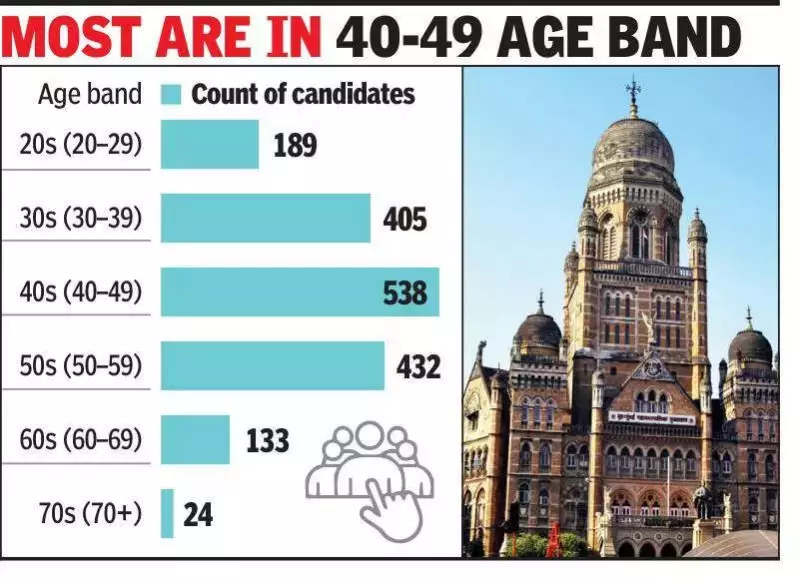
However, Mhadgut represents a small demographic. Data extracted from affidavits by Excelsoft Technologies Ltd. shows that of the 1,721 candidates contesting, the largest groups are in their 40s (538 candidates) and 50s (432). Another 405 are in their 30s, and 189 are in their 20s. In stark contrast, only 133 candidates are in their 60s, and a mere 24 are aged 70 or above.

Another senior candidate, Dr. Narendrakumar Sharma (73), a cardiologist with declared assets of Rs 5.25 crore, is a first-time contender. Having organized free medical camps and civic works in Borivli East for years, he agreed to contest from Dahisar when his home ward was reserved for women. "I am still lean and fit. I run marathons... I realised this is the perfect time to immerse myself in social work," he states.
Adding to the senior voice is Vinayak Suryavanshi, 70, a retired BEST driver. Hailing from Latur but deeply connected to Mumbai through activism, he says, "I am standing for the poor. For the voiceless—for people like me."
The Young and the Driven: A Generation's Frustration
At the opposite end of the spectrum is the youth, driven not just by ambition but often by frustration with the status quo. Sumit Sahil (21) is one of the four youngest candidates in the election. Contesting from Jharimari in Saki Naka, his decision to enter politics was born from daily observations of civic apathy.
With the local corporator's office right outside his house, Sumit witnessed a constant queue of people with unresolved issues. "Every day I see a long queue of people coming to get their problems resolved... These are not big problems: someone's garbage is not picked, someone has a clogged drain... But no one is really interested in solving their issues," he explains. This daily procession of grievances was the final push. "That is why I decided not to take up a job, but to enter the fray," he asserts.
A Demographic Cross-Section of Civic Aspirations
The BMC election candidate list presents a fascinating demographic cross-section of Mumbai. The data underscores a political landscape dominated by candidates in their prime working years (30s to 50s), who collectively form the overwhelming majority. The significant number of candidates in their 20s, like Sumit Sahil, indicates a growing inclination among the youth to engage directly with local governance, often spurred by grassroots issues.
Conversely, the small cohort of senior candidates, led by figures like Krishna Mhadgut and Dr. Sharma, represents a blend of post-retirement social commitment and seasoned life experience. Their candidacies challenge preconceived notions about energy, capability, and the appropriate age for political participation.
The stories emerging from this election highlight a universal truth for Mumbai's voters: the desire for effective, responsive, and accessible corporators. Whether motivated by a lifetime of witnessing civic neglect or by the fresh-eyed frustration of youth, these candidates from across the age spectrum are vying to address the city's most pressing local issues—from clogged drains and garbage collection to water pipelines and streetlights.