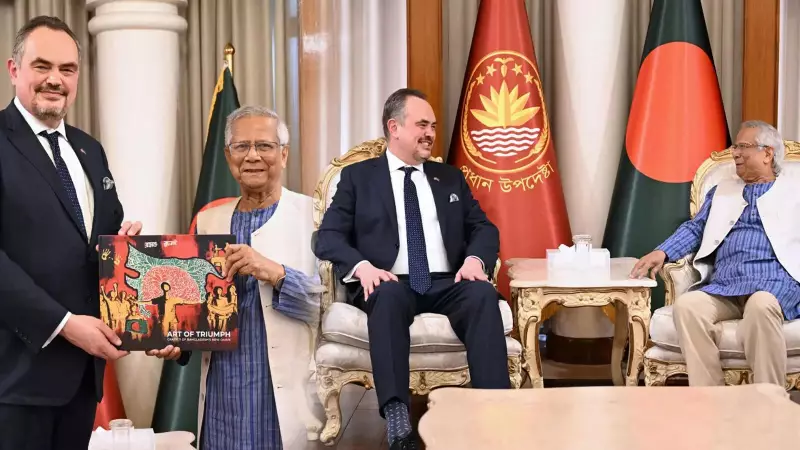
Yunus's Map Gift to US Envoy Ignites Diplomatic Firestorm Over India's Northeast
A seemingly innocuous book presentation has escalated into a significant diplomatic incident, casting a shadow over South Asian relations. Bangladesh's interim leader, Muhammad Yunus, recently handed a publication to the US Ambassador, but it was the cover that spoke volumes—featuring a Greater Bangladesh map that controversially includes India's northeastern states as part of Bangladeshi territory.
Historical Context and Alarming Patterns
This is not an isolated occurrence. The same book was previously gifted to a Pakistani military official, and for years, radical groups within Bangladesh have actively promoted similar cartographic imagery. These actions suggest a deliberate pattern rather than a mere oversight, raising red flags in Indian diplomatic circles.
Yunus's recent statements from China have only compounded the unease. He described India's northeast as dependent on Bangladesh and openly invited Beijing to explore opportunities in that region. Such remarks, coupled with the map incident, are perceived as provocative moves that challenge India's territorial integrity.

India's Firm Response and Strategic Concerns
India has swiftly pushed back against these developments, emphasizing that the northeast is a strategic hub crucial to national security and economic growth, not a vulnerability to be exploited. The Indian government has reiterated its commitment to safeguarding its borders and sovereignty, viewing these actions as unwarranted provocations.
The timing of this incident is particularly sensitive, as Dhaka appears to be warming its ties with Beijing and Islamabad. In geopolitics, symbols often carry more weight than statements, and the placement of such a map on the diplomatic table sends a powerful message. It underscores the growing complexities in regional alliances and the potential for heightened tensions.
Broader Implications for Regional Stability
This episode highlights how seemingly minor gestures can have far-reaching consequences in international relations. The use of maps in diplomatic exchanges is a loaded act, often reflecting deeper territorial ambitions or political posturing. As South Asia navigates shifting power dynamics, such incidents serve as reminders of the fragile balance that must be maintained to ensure peace and cooperation.
Observers note that the situation demands careful diplomatic handling to prevent escalation. The involvement of major powers like the United States and China adds another layer of complexity, making it a critical issue to watch in the coming months. The outcome could influence not only bilateral relations but also the broader geopolitical landscape of the region.