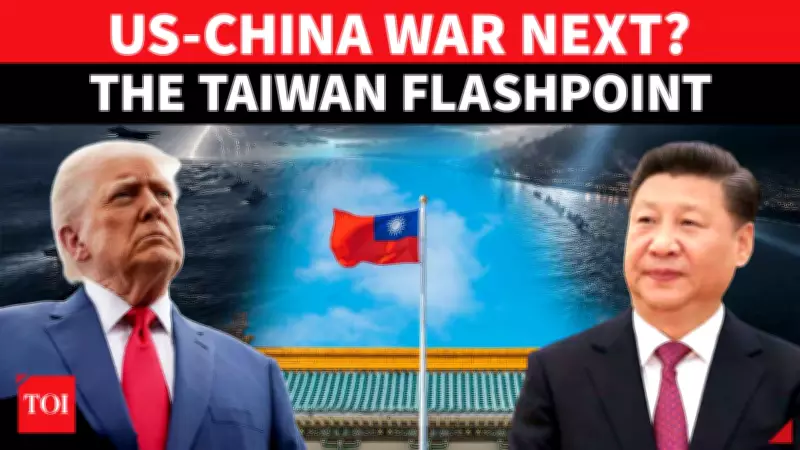
Taiwan has long been the most sensitive flashpoint in US–China relations, and in 2026 the debate around it has returned with renewed urgency after Chinese President Xi Jinping referenced the idea of the “Thucydides Trap” during a high-stakes summit with US President Donald Trump in Beijing. His warning that mishandling Taiwan could trigger “clashes and even conflicts” has reignited global concern over whether rivalry between the world’s leading superpower and its rising challenger could slip into open confrontation.
This explainer traces how tensions over Taiwan have evolved from the Chinese Civil War in 1949 through the Taiwan Strait crises of the 1950s, the 1995–96 military standoff, and modern flashpoints such as the 2022 Pelosi visit. It also examines how Taiwan’s strategic importance has expanded beyond geopolitics into global semiconductor supply chains, Indo-Pacific security, and world trade stability.
Drawing on expert views, including warnings from defence analysts that Taiwan is heavily fortified and any conflict would be catastrophic, the story highlights why the greatest risk today may not be deliberate war but accidental escalation. As US–China competition intensifies across trade, technology, and military domains, Taiwan remains the central pressure point where global stability could be tested.

Historical Context of Taiwan Tensions
The roots of the Taiwan issue trace back to the Chinese Civil War, which ended in 1949 with the Communist Party of China taking control of the mainland, while the Kuomintang retreated to Taiwan. Since then, the island has remained under a separate administration, though Beijing considers it a part of China under the One-China principle. The Taiwan Strait crises of the 1950s saw military confrontations between the two sides, with the United States intervening to protect Taiwan. The 1995–96 missile crisis further escalated tensions when China conducted military exercises near Taiwan in response to then-Taiwanese President Lee Teng-hui's visit to the US.
The Thucydides Trap and Modern Implications
The term “Thucydides Trap,” popularized by political scientist Graham Allison, describes the historical tendency for conflict when a rising power challenges an established one. Xi Jinping’s reference to this concept underscores the gravity of the current US-China rivalry. Taiwan’s strategic importance has grown beyond geopolitics: it is a critical hub for semiconductor manufacturing, with companies like TSMC producing chips essential for global electronics. Any disruption to Taiwan’s stability could have cascading effects on global supply chains, the Indo-Pacific security architecture, and world trade.
Defence analysts warn that Taiwan is one of the most heavily fortified regions in the world, with both China and the US maintaining significant military assets in the area. A direct conflict would be catastrophic, potentially drawing in regional allies and leading to immense human and economic costs. The greatest risk today may not be a deliberate war but an accidental escalation, such as a miscalculation during routine patrols or a misinterpretation of signals. As US-China competition intensifies across trade, technology, and military domains, Taiwan remains the central pressure point where global stability could be tested.