The Vikings and the Contested Discoveries of Greenland and America
When US President Donald Trump recently expressed interest in resource-rich Greenland, he echoed historical ambitions that stretch back centuries. History reveals he is far from the first to eye this strategic island. The story intertwines with Viking explorations that may have reached America long before Christopher Columbus.
The Mysterious Vinland Map
In 1965, Yale University announced a remarkable acquisition: an antique map dated 1440. This map depicted the world in typical medieval style but with two shocking additions. It showed Greenland in fine detail and included Vinland, a coastal area in North America. This discovery sparked excitement among scholars.
Academic Dr Anne Millard notes in her 1994 work Eric the Red: The Vikings Sail the Atlantic that this suggested someone reached America more than fifty years before Columbus. They knew the name Vinland and had drawn a map. The question remained: who were these early explorers?

Viking Sagas and Historical Claims
According to Viking sagas, it was Norse seafarers who founded the first European colony in Greenland. They eventually landed in America. Dr Millard explains that Vikings were inhabitants of Denmark, Norway, and Sweden from 750 to 1100 AD. Population growth pushed them to explore new lands.
Some moved north for trade, while others sought homes abroad. Their history was preserved through oral stories called sagas, written down only around the 13th century. Another school of thought argues this history stems from colonial-era entitlement, where English migrants promoted Viking discovery claims.
Eric the Red's Journey
Among these explorers was Eric Thorvaldsson, known as Eric the Red. Forced to leave Norway after a feud, he settled in Iceland. Continued conflicts led to his outlaw status. Eric and his men then sailed to Gunnbjarnar Skerries, landing on Greenland's east coast near a glacier they named Blueshirt.
They sailed south to warmer waters, spending three years exploring. During a summer voyage, Eric discovered an island he later called Greenland. In 986 AD, twenty-five ships set out with him, but only fourteen reached their destination. The southern tip proved farmable, despite Greenland's icy reputation.
Greenland already had a native Eskimo population living farther north, surviving through seal hunting. Eric and his wife Thjodhild built a farmstead called Brattahlid at the Eastern Settlement. Archaeologists have found remains believed to be from Eric's colony.
Leif Erikson's Voyage to Vinland
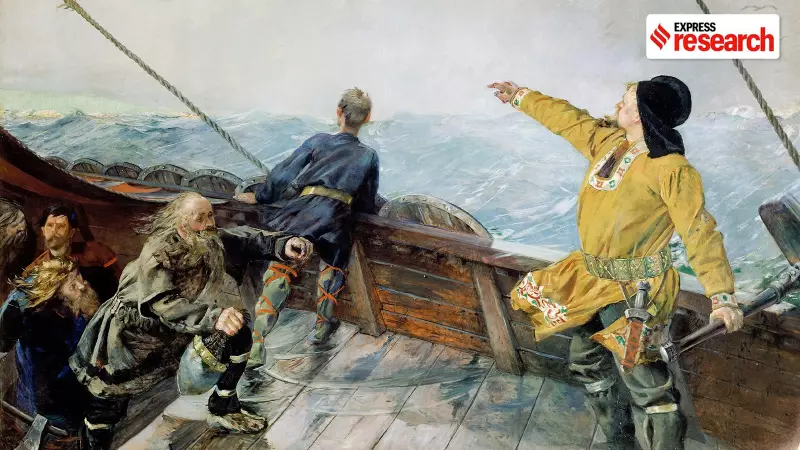
Eric's eldest son, Leif, followed in his footsteps. On one voyage southwest, Leif and his sailors reached a land of ice and rock, naming it Helluland (Slab-land). They continued to a forested coast called Markland (Forest-land), then sailed south to a mild, attractive coast.
They found grass for cattle, salmon in rivers, and grapes. Leif named this place Vinland (Wine-land). Scholars debate Vinland's location, with many believing it corresponds to the New England area today.
Archaeological Evidence and Debate
Between 1960 and 1968, excavations at L'Anse aux Meadows in Newfoundland uncovered building foundations resembling Viking settlements in Greenland. Small Viking items were also found. While consensus exists that this was a Viking site, whether it was Leif's settlement remains uncertain.
The Vinland Map's authenticity is hotly contested. In 1972, tests revealed titanium dioxide in the ink, a substance not available until the 20th century, suggesting it was a fake. However, 1984 tests showed only minute quantities, making conclusions inconclusive.
Isolated Viking objects found in North America may have been brought over in the 19th century. The central question persists: did Columbus discover America, or did he build on earlier Viking findings?
This contested history gains relevance today as geopolitical interests in Greenland resurface. The Viking sagas and archaeological clues continue to fuel debates about early transatlantic exploration.