

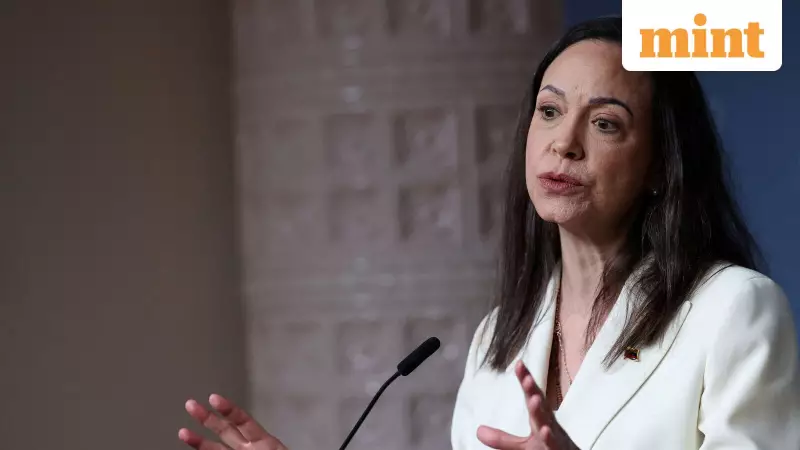
US Justice Memo Cites Venezuelan Opposition's Support in Legal Justification for Maduro's Removal
A recently released Justice Department memo has shed light on the legal reasoning behind the United States military operation against Venezuelan leader Nicolás Maduro. According to people familiar with the matter, the memo asserted that support from the Venezuelan opposition, led by Nobel Peace Prize laureate Maria Corina Machado, significantly strengthened President Trump's legal case for overthrowing Maduro.
Redacted Justification Reveals Opposition's Role
The Justice Department publicly released a redacted version of the memo on Tuesday afternoon. While the public document outlined arguments about presidential authority and international law, thick black lines concealed a crucial justification. Behind those redactions, the memo stated that the opposition's lobbying could be interpreted as a request from Venezuela's legitimate government to depose what they considered a usurper in Caracas.
This redacted section appears on the last paragraph of Page 6 in the 22-page document. One of the unredacted footnotes specifically cites Machado's comments that escalating U.S. pressure represented the only way to free Venezuela from Maduro's rule.

Contradictory Stances on Venezuelan Leadership
The memo's reliance on Machado's legitimacy as a legal justification creates a striking contradiction. While citing her opposition movement as Venezuela's legitimate government, the Trump administration has simultaneously thrown its support behind Maduro's vice president, Delcy Rodriguez. The administration continues to work with Rodriguez as the acting leader of the country.
President Trump has publicly praised Rodriguez, calling her very good for the position. Meanwhile, he has dismissed Machado, stating she lacks the support and respect needed to lead Venezuela. This comes despite Machado's Nobel Peace Prize recognition for her democracy activism in Venezuela.
Machado's Alliance with Trump Administration
Maria Corina Machado has aligned herself closely with the Trump administration in recent months. She publicly supported the president's threats of military intervention before the actual raid occurred. In October, as the U.S. intensified its campaign of airstrikes against alleged drug-smuggling vessels in the Caribbean, Machado stated that escalation represented the only way to force Maduro to understand it was time to leave.
Her alliance reached such a level that she even offered to share her Nobel Peace Prize with President Trump. The Nobel Committee quickly issued a rare clarification, emphasizing that the award cannot be transferred to another person under any circumstances.
Legal Precedents and International Law Concerns
The Justice Department memo doesn't rely solely on Machado's comments in its legal arguments. It cites numerous precedents, including a president's constitutional authority to launch operations, ongoing U.S. counterdrug operations in Latin America, and past missions where the military collaborated with law enforcement to capture alleged terrorists.
However, legal experts have raised concerns about using opposition consent as justification for military action. Former State Department lawyer Scott Anderson notes that citing the consent of a U.S.-recognized opposition leader marks a departure from past U.S. practice. He explains that such consent would only satisfy international law requirements if Machado's government could exercise effective control over Venezuelan territory and institutions, which isn't the current situation.
Anderson draws parallels to the 1989 U.S. operation in Panama, where officials didn't rely on support from Panama's government-in-exile as legal basis for deposing Manuel Noriega.
Current Status and Broader Context
The United States captured Nicolás Maduro earlier this month and transported him to New York City to face federal narco-trafficking charges. He currently remains in a federal jail in Brooklyn.
The Justice Department memo also addresses Maduro's alleged leadership of the Cartel de los Soles, described as a shadowy group of high-ranking officers involved in drug trafficking. However, the document acknowledges that intelligence agencies have struggled to corroborate reports of Maduro personally directing this activity.

Since the raid, U.S. prosecutors have softened their earlier characterization of the Cartel de los Soles. They now frame it less as a hierarchical organization led by Maduro and more as a patronage network among corrupt senior officials.
The memo further notes that Maduro's departure would likely create mass confusion in Venezuela, with no clear frontrunner to succeed him. Before the operation, U.S. intelligence assessments determined that top members of Maduro's regime, including Vice President Rodriguez, would be best positioned to lead a temporary government in Caracas.
The Justice Department initially provided a copy of the redacted memo when contacted for comment. A department spokesman declined to comment on the record when asked specifically about the redacted section related to the Venezuelan opposition's role.





