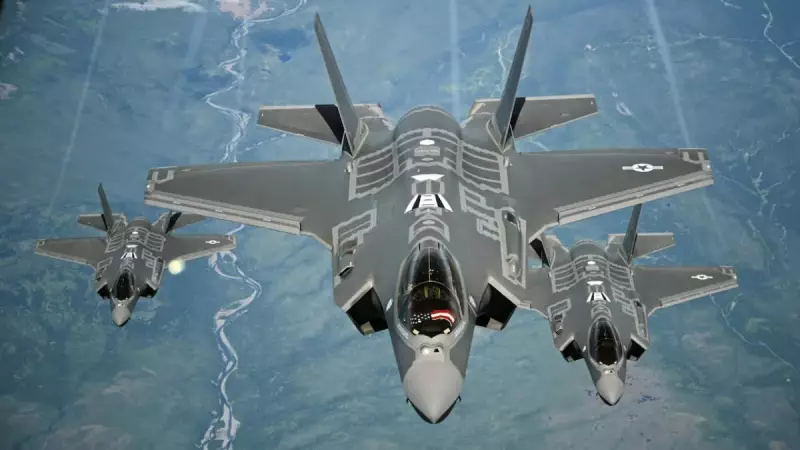
US Greenlights Major F-35 Sale to Saudi Arabia
In a significant policy shift, President Donald Trump has officially confirmed that the United States will proceed with the sale of advanced F-35 stealth fighter jets to Saudi Arabia. The announcement was made by Trump himself to reporters in the Oval Office on November 17, just a day before he was scheduled to host Saudi Crown Prince Mohammed bin Salman at the White House.
"I will say that we will be doing that, we'll be selling F-35s," President Trump stated, directly confirming the major arms deal. This decision comes despite clear concerns raised by Pentagon intelligence officials and key allies in the region about the potential consequences of such a transfer.
Details of the Deal and Regional Reactions
The proposed deal is substantial in both scale and value. Saudi Arabia has formally requested to purchase as many as 48 F-35 fighters from the American defense giant Lockheed Martin. This multibillion-dollar agreement would make the Royal Saudi Air Force the first Arab military in the world to acquire and operate the formidable fifth-generation stealth aircraft. Until now, Israel has held the distinction of being the sole operator of the F-35 in the entire Middle East.

The Israeli reaction was swift and firm. On the very same day as Trump's announcement, the Israeli Defense Forces (IDF) delivered a formal position paper to their political leadership objecting to the sale. The document, obtained by Ynet, explicitly warned that providing F-35s to Saudi Arabia could critically undermine Israel's qualitative military edge (QME) in the region, a status guaranteed by U.S. law.
The IDF assessment was stark, stating, "Israel's air superiority in the Middle East depends on maintaining exclusive access to fifth-generation stealth aircraft." The military also raised a practical concern, warning that Saudi orders could occupy Lockheed Martin's production lines, thereby delaying Israel's own planned orders for additional F-35 squadrons.
Wider Security Implications for India and Beyond
The ripple effects of this decision extend far beyond the Middle East, causing significant apprehension in New Delhi. India's primary concern stems from a recent defense pact between Saudi Arabia and Pakistan. This agreement stipulates that an attack on either nation would be considered an attack on both.
Strategic analysts have warned that this pact, combined with the F-35 sale, could potentially enable Pakistan to gain indirect access to advanced U.S. military technology through its close ally, Saudi Arabia. This development poses a direct security challenge for India, altering the strategic balance in South Asia.
Further complicating the matter are warnings from the U.S. Defense Intelligence Agency. The agency's report highlighted the risk of China potentially acquiring the F-35's sensitive advanced technology, citing Beijing's deepening defense ties with Riyadh. China is now Saudi Arabia's largest trading partner, and the two nations have conducted joint naval exercises in recent years, underscoring the growing strategic partnership.
While U.S. law mandates that Israel must be provided with the weapons needed to maintain its QME over neighboring Arab nations, Trump administration officials have indicated they can provide the necessary assurances to Israel without specifying what additional capabilities might be offered to counterbalance the Saudi acquisition of the F-35s.