UAE President's Swift India Trip Reinforces Strong Bilateral Ties
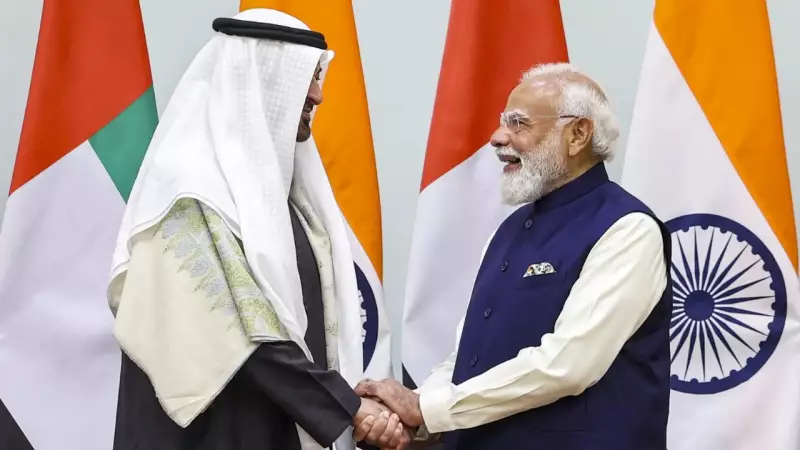
The UAE President Sheikh Mohamed bin Zayed Al Nahyan visited India on January 19. This marked his third official trip since becoming president and his fifth in the last ten years. The visit lasted only about three hours, but its importance was far greater than its short duration suggests.
Economic Partnership Forms the Core
India and the UAE have built a comprehensive strategic partnership over the years. Trade, energy, investment, defense, and technology cooperation form the backbone of this relationship. The India-UAE Comprehensive Economic Partnership Agreement (CEPA) has been a game-changer since it started in 2022.
Non-oil trade between the two countries surpassed $84 billion in 2024. This makes the UAE India's third-largest trading partner. During the visit, both leaders reviewed CEPA's progress. They agreed to simplify trade measures further, tackle non-tariff barriers, and boost cooperation in services, digital trade, and new areas like green hydrogen and artificial intelligence.

The UAE has become a major investor in India. Sovereign wealth funds such as Abu Dhabi Investment Authority and Mubadala have put significant money into infrastructure, renewable energy, logistics, ports, and fintech. India's steady growth, predictable policies, and large infrastructure projects attract long-term Emirati capital. The leadership meeting reaffirmed this confidence and emphasized moving beyond simple trade to strategic economic interdependence.
Energy Cooperation and Clean Energy Transition
Energy collaboration remains a key pillar. The UAE is one of India's top crude oil suppliers. It has played a vital role in ensuring India's energy security during market fluctuations. Beyond oil, both nations are now working together on clean energy. Joint projects in solar energy, green hydrogen, and strategic petroleum storage show a forward-looking partnership. This aligns with India's climate goals and the UAE's aim to be a global energy transition hub.
Strategic Context in a Turbulent Region
Looking only at bilateral economics misses the deeper strategic meaning of this visit. West Asia is currently facing multiple crises and strategic shifts. The Gaza conflict has entered a more complex phase with risks of spreading regionally. Iran is dealing with internal political changes and economic pressures, which could lead to external intervention. Tensions between Saudi Arabia and the UAE continue over Yemen, where their strategic goals differ.
In this context, the wider region's defense and security developments are noteworthy. In September 2025, Saudi Arabia and Pakistan signed the Strategic Mutual Defence Agreement. This includes a collective defense clause. Turkey is reportedly in talks to join, potentially creating a trilateral security arrangement across South Asia and West Asia. This emerging axis affects regional security and power balances in the Islamic world and the Indo-Pacific.
UAE's Strategic Outreach to India
Sheikh Mohamed's outreach to India holds strategic weight here. The UAE has traditionally pursued an independent foreign policy focused on regime security, economic diversification, and regional influence. While cooperating with Riyadh on many issues, Abu Dhabi has also shown a willingness to take its own path, especially in Yemen and the Horn of Africa.
Engaging India more closely serves several UAE objectives. It diversifies strategic partnerships beyond traditional Gulf alignments. It strengthens the UAE's position as a key regional player. It signals intent to work with rising powers rather than relying only on old security frameworks.
India's Role as a Different Partner
India represents a fundamentally different partner from Pakistan. India's foreign policy is based on strategic autonomy and national interest, not ideology. This pragmatic approach has allowed India to build deep partnerships across geopolitical divides. Relations with the UAE exemplify this. Cooperation now extends beyond bilateral formats to minilateral and multilateral platforms, including West Asia-Indo-Pacific linkages, maritime security dialogues, and technology partnerships.

Prime Minister Narendra Modi and President Sheikh Mohamed reviewed the full scope of bilateral cooperation during the visit. They noted that the partnership has grown steadily over the past decade. This continuity reflects sustained political will, converging strategic interests, and a shared vision for stability and prosperity in a volatile region.
Symbolism of the Brief Visit
The visit's brevity itself carries symbolic meaning. In diplomacy, a short visit during regional instability signals reassurance and alignment, not negotiation. It shows the relationship is mature enough not to need lengthy talks and resilient enough to handle external shocks. For the UAE, engaging India now reinforces its image as a pragmatic power seeking balance, not bloc politics. For India, hosting Sheikh Mohamed amid turbulence reinforces its role as a stable, credible, and increasingly essential partner in West Asia.
There is subtle strategic messaging here too. As Saudi Arabia deepens defense ties with Pakistan and potentially Turkey, the UAE's emphasis on India shows a preference for partnerships based on economic strength, political stability, and strategic predictability. India's secular polity, self-sustained economy, and growing global presence contrast with Pakistan's aid-dependent economy and internal political fragility. For Abu Dhabi, aligning more with India is a rational hedge against uncertainty, not an act of rivalry.
A Strategic Signal, Not a Transaction
Ultimately, Sheikh Mohamed's January visit to India should be seen less as a transactional diplomatic event and more as a strategic signal. It reflects the UAE's intent to anchor future partnerships in economic resilience, diversified security ties, and engagement with rising powers. For India, it affirms the success of a foreign policy that prioritizes strategic autonomy, multi-alignment, and long-term partnerships over ideological affiliations.
In an era of conflict, shifting alliances, and contested regional orders, the India-UAE relationship stands out for its consistency and depth. The symbolism of this brief visit lies in what it does not try to do. It does not announce dramatic new pacts or sweeping declarations. Instead, it quietly reinforces an existing strategic understanding. In doing so, it sends a clear message: an emerging India, economically robust, geopolitically balanced, and strategically autonomous, is a more reliable and future-ready partner than transactional alliances rooted in dependency.