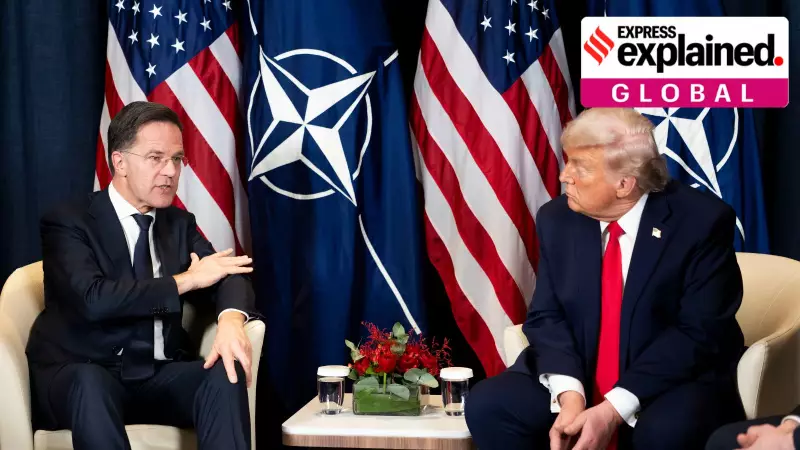
Trump's NATO Assertions at Davos: A Detailed Examination
During his Special Address at the World Economic Forum in Davos, Switzerland, on January 21, 2026, US President Donald Trump made striking comments about the North Atlantic Treaty Organization (NATO). He reiterated his interest in Greenland, stating the US claims "right, title and ownership" over the Danish territory, and launched a critique of the alliance, asserting that the United States derives minimal benefits from its membership.
"We've never got anything out of NATO," Trump declared, emphasizing later that "it's always a one-way street" where the US contributes disproportionately without receiving commensurate returns. This statement forms the core of a contentious debate, prompting a closer look at the facts surrounding NATO's operations and America's role within it.
Understanding NATO and Its Foundational Principle
NATO, or the North Atlantic Treaty Organization, was established in 1949 following World War II through the North Atlantic Treaty. Its defining feature is the mutual defense commitment outlined in Article 5, which treats an attack on one member as an attack on all. This principle has been invoked only once in history—specifically for the United States.

In response to the September 11, 2001, terrorist attacks, NATO allies mobilized to support America. This included a military intervention in Afghanistan, where NATO later assumed command of the International Security Assistance Force (ISAF). Contributions from members like Denmark, which deployed 18,000 troops and suffered significant casualties, underscore the alliance's collective action in America's defense.
Analyzing Trump's Claims on Defense Spending
Trump argued that other NATO members have historically underfunded their defense budgets, leaving the US to shoulder the burden. "Most of the countries weren't paying anything. The United States was paying for virtually 100% of NATO," he claimed, adding that he halted this trend.
Data from NATO reveals a more nuanced picture:
- US defense spending constituted 63% of the total alliance expenditure in 2024, down from 72% in 2016.
- While substantial, this contradicts the notion of America funding 100% of NATO.
- In terms of GDP percentage, the US ranks sixth at 3.22%, behind leaders like Poland (4.48%), Lithuania (4%), and Latvia (3.73%).
Furthermore, non-US members increased their defense spending from $292 billion in 2016 to $482 billion in 2024, with 18 of 31 members meeting the 2% GDP target in 2024, up from just four in 2016. This growth is partly driven by the Russia-Ukraine conflict, highlighting evolving security dynamics.
The 5% GDP Target and Organizational Contributions
Trump noted that NATO allies have agreed to raise defense spending to 5% of GDP by 2035, a move he attributes to his advocacy. This target includes:
- 3.5% for core defense needs such as personnel and equipment.
- 1.5% for security measures like cybersecurity and infrastructure resilience.
No country achieved this 5% benchmark in 2025, indicating ongoing challenges in meeting these ambitious goals. Additionally, the US contribution to NATO's organizational budget has decreased from about 22% in 2017 to approximately 16% currently, following negotiations by Trump upon his return to the White House in 2025.
Conclusion: Assessing the Validity of Trump's Statements
Trump's portrayal of NATO as a one-sided arrangement where America gains nothing is factually inaccurate. The invocation of Article 5 post-9/11 demonstrates tangible support from allies, while defense spending trends show increased contributions from other members, albeit with the US still playing a dominant role. As geopolitical tensions, particularly with Russia, influence alliance dynamics, these discussions underscore the complexities of international cooperation and burden-sharing in global security frameworks.