Trump's Renewed Campaign for Greenland Control Amid Heightened Global Tensions
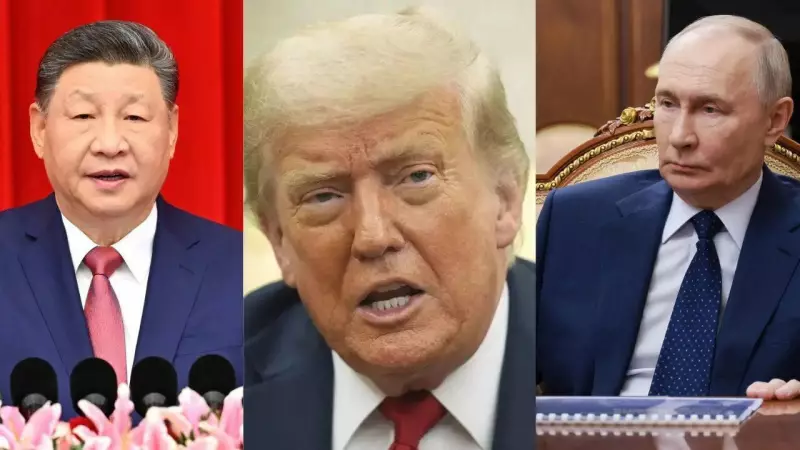
US President Donald Trump has reignited his controversial campaign to bring Greenland under American control, this time amid escalating diplomatic and economic tensions with European nations. Citing national security concerns and perceived threats from both Russia and China, Trump has significantly intensified his rhetoric—including refusing to rule out how far he would go to secure the strategically important Arctic island.
The Nobel Prize Connection and Escalating Rhetoric
In a surprising development, Trump has explicitly linked his renewed Greenland ambitions to his disappointment over the Nobel Peace Prize. In a letter to Norway's Prime Minister Jonas Gahr Støre, the 47th US commander-in-chief wrote that he was "no longer bound to think of peace" after being overlooked for the world's most prestigious peace award.
Trump argued in his correspondence: "Considering your country decided not to give me the Nobel Peace Prize for having stopped 8 wars plus, I no longer feel an obligation to think purely of peace. The world is not secure unless we have complete and total control of Greenland."

Days later, Trump made additional comments about the Nobel situation, stating: "I don't care about the Nobel Prize. First of all, a very fine woman (Maria Corina Machado) felt that I deserved it and really wanted me to have the Nobel Prize, and I appreciate that. If anybody thinks that Norway doesn't control the Nobel Prize, they are just kidding."
Why Greenland Matters Strategically
Trump is not the first American president to express interest in controlling Greenland, the world's largest island with a population of just 56,609 as of 2023. However, his current push represents a significant escalation from his 2019 proposal during his first term, which was swiftly rejected by both Greenlandic and Danish leaders.
Analysts point to several key factors driving American interest in Greenland:
- Strategic Location: Greenland lies between the United States, Europe, and Russia, making it crucial for early-warning systems against potential missile attacks.
- Mineral Wealth: The island contains vast untapped resources including oil, gas reserves, critical mineral deposits, and rare earth elements essential for modern technology.
- Shipping Advantages: Rapid ice melt could open new sea lanes that would significantly reduce Asia-Europe travel times compared to current routes through the Suez Canal.
- Naval Importance: Greenland forms a critical part of the GIUK (Greenland–Iceland–United Kingdom) Gap, a key naval chokepoint linking the Arctic and Atlantic oceans.
- Missile Defense: Trump has emphasized Greenland's importance for the "Golden Dome," his ambitious $175 billion missile defense system announced in May last year.
Examining the Russian and Chinese 'Threats'
Trump has repeatedly claimed that Greenland faces imminent threats from Russia and China, stating: "If we don't go in, Russia's going to go in, and China's going to go in." However, evidence suggests these claims may be exaggerated.
Regarding Russia: Russian foreign minister Sergei Lavrov has explicitly denied any interest in Greenland, stating it was "not an object of Russian interest" and warning that US rhetoric risked creating unnecessary tensions within NATO. Experts confirm there is no evidence of Russian destroyers or submarines operating around Greenland as Trump has claimed.
Regarding China: Beijing's interest appears primarily economic rather than military. Chinese firm Shenghe Resources holds a minority stake in Greenland's Kvanefjeld mining project, but large-scale extraction has yet to begin due to environmental and logistical challenges. China has declared itself a "near-Arctic state" but maintains its activities focus on scientific research and resource cooperation rather than territorial expansion.

Existing Security Frameworks and Future Implications
The United States already maintains a significant military presence in Greenland through the 1951 Defence of Greenland treaty, which allows American troops on the island. The remote Pituffik Space Base (formerly Thule Air Base) supports missile warning, missile defense, and space surveillance operations for both the US and NATO.
European policy experts argue that existing frameworks—including NATO, bilateral defense agreements, and Arctic Council mechanisms—are already managing Arctic security risks effectively. Fabian Zuleeg, chief executive of the European Policy Centre, has stated that Trump's framing of Russia and China as imminent dangers to Greenland is "misleading" and that "there is no serious or immediate security threat that would justify US talk of using force."
Any attempt to forcibly alter Greenland's status would trigger NATO's Article 5, potentially placing Washington in direct conflict with its own allies. Such a move could also set a destabilizing global precedent while providing diplomatic advantages to Russia and China in their respective regional ambitions.
As EU foreign policy chief Kaja Kallas noted succinctly: "China and Russia must be having a field day. They are the ones who benefit from divisions among allies."