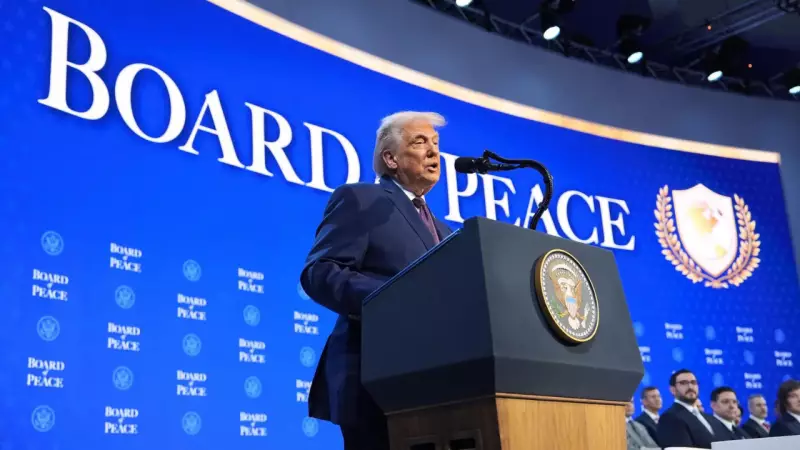
In a significant diplomatic development, US President Donald Trump has formally withdrawn his invitation for Canada to participate in the newly proposed Board of Peace. This decision came directly after Canadian Prime Minister Mark Carney publicly rejected Trump's claims regarding Canada's economic and political dependence on the United States.
Trump's Official Withdrawal Letter
President Trump announced this move through a post on his Truth Social platform. In his message addressed to Prime Minister Carney, Trump wrote, "Dear Prime Minister Carney: Please let this Letter serve to represent that the Board of Peace is withdrawing its invitation to you regarding Canada’s joining, what will be, the most prestigious Board of Leaders ever assembled, at any time." This statement effectively rescinds Canada's potential role in what Trump describes as a historic assembly of global leaders.
Escalating Tensions at World Economic Forum
The conflict between the two leaders intensified during the recent World Economic Forum held in Davos. Prime Minister Carney, in his Tuesday speech, took a firm stance against what he characterized as a "ruptured" global order predominantly led by the United States. He received a standing ovation for his critique of the international system.

In response, President Trump, during his own address, made a pointed remark about Canada's relationship with the US. He stated, "Canada lives because of the United States." This comment set the stage for further confrontation between the North American neighbors.
Carney's Forceful Rebuttal in Quebec
Prime Minister Carney delivered a powerful counterargument during a national address in Quebec City on Thursday. He directly addressed Trump's assertion, declaring, "Canada doesn't live because of the United States. Canada thrives because we are Canadian." While acknowledging the "remarkable partnership" between the two nations, Carney emphasized Canada's independent strength and identity.
He further positioned Canada as a potential model for democratic values in an era of global challenges. Carney elaborated, "Canada can't solve all the world's problems, but we can show that another way is possible, that the arc of history isn't destined to be warped towards authoritarianism and exclusion."
Critique of the International Order
In his Davos speech, Carney provided a detailed analysis of the flaws within the current US-led, rules-based global system. He argued that the international order has functioned with significant inconsistencies. "We knew the story of the international rules-based order was partially false, that the strongest would exempt themselves when convenient, that trade rules were enforced asymmetrically," Carney stated.
He acknowledged that despite its imperfections, this system had provided certain global benefits under American leadership. "This fiction was useful, and American hegemony, in particular, helped provide public goods, open sea lanes, a stable financial system, collective security and support for frameworks for resolving disputes," he noted.
However, Carney concluded that this arrangement is no longer sustainable. He declared, "We placed the sign in the window. We participated in the rituals, and we largely avoided calling out the gaps between rhetoric and reality. This bargain no longer works. Let me be direct. We are in the midst of a rupture, not a transition."
Trump's Direct Challenge
President Trump responded to Carney's criticisms with a direct challenge during his subsequent speech. Referring to Carney's earlier remarks, Trump said, "I watched your prime minister yesterday. He wasn't so grateful. Canada lives because of the United States. Remember that, Mark, the next time you make your statements." This exchange highlights the growing diplomatic friction between the two leaders and their contrasting visions of international relations.

The withdrawal of Canada's invitation to the Board of Peace represents more than a simple diplomatic gesture. It symbolizes the deepening divide between the United States and Canada regarding their roles in global governance and the future of international cooperation. This incident underscores the ongoing recalibration of traditional alliances in contemporary geopolitics.