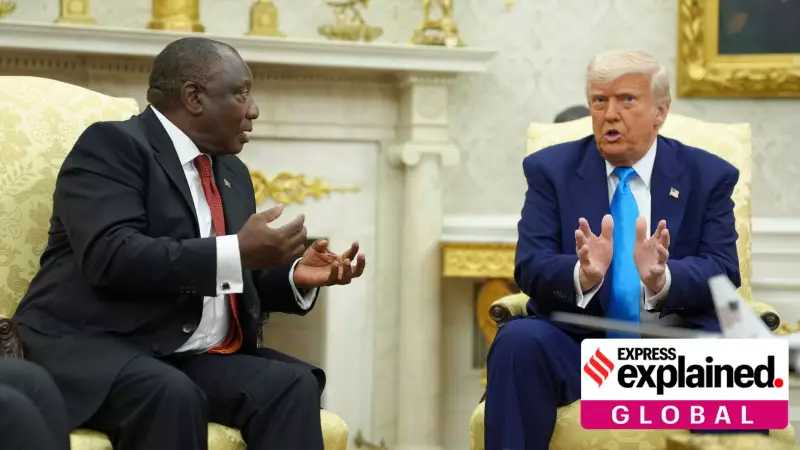
In a dramatic diplomatic move, US President Donald Trump has announced that no American government officials will attend the upcoming G20 Summit in South Africa, citing alleged human rights abuses and violence against white farmers in the African nation.
The Controversial Announcement
President Trump made the declaration on Friday, November 7, 2025, through a social media post that directly accused the South African government of tolerating violence against Afrikaner communities. "Afrikaners are being killed and slaughtered, and their land and farms are being illegally confiscated," Trump wrote, emphasizing that "No U.S. Government Official will attend as long as these Human Rights abuses continue."
The South African government swiftly responded to what it called a "regrettable" decision, setting the stage for a major diplomatic confrontation between the two nations just weeks before the important international gathering.

Understanding the Afrikaner Community
At the heart of this controversy are the Afrikaners, white South Africans descended primarily from 17th century Dutch settlers, along with French and German immigrants. This community, which speaks the Afrikaans language, has historically maintained significant rural landholdings across South Africa.
The current population demographics reveal a stark reality: white South Africans constitute only about 7% of the country's 62 million people, yet according to a 2017 land audit, they own approximately 72% of all agricultural landholdings.
Historical Context of Trump's Accusations
This isn't the first time President Trump has raised concerns about South Africa's treatment of white farmers. The issue dates back to his first presidential term between 2017 and 2021. In August 2018, following a Fox News segment on land redistribution plans, Trump tweeted about "farm seizures and expropriations and the large-scale killing of farmers" in South Africa.
The controversy gained additional momentum through support from prominent figures like Elon Musk, the South African-born billionaire who has repeatedly criticized what he calls "racist" land ownership laws in his home country. Musk has specifically accused President Cyril Ramaphosa of failing to address violence against white farmers.
Earlier this year, Trump escalated the matter significantly by signing an executive order titled "Addressing Egregious Actions of the Republic of South Africa" in February 2025. The order described purported injustices against "ethnic minority Afrikaner" people as a "massive Human Rights VIOLATION" and threatened to "cut off all future funding to South Africa" pending investigation.
The Land Reform Legislation
The immediate trigger for the current diplomatic crisis appears to be South Africa's Expropriation Act passed in January 2025. This landmark legislation enables the state to seize land without compensation under specific circumstances for public purposes or public interest.
The new law effectively creates a legal framework for expropriation under Section 25(2) of the South African constitution, replacing the apartheid-era Expropriation Act of 1975. The previous legislation operated on the "willing seller, willing buyer" principle that often delayed land redistribution by allowing landowners to sell to the highest bidder.
President Ramaphosa has defended the legislation as "a constitutionally mandated legal process that ensures public access to land in an equitable and just manner as guided by the constitution." Importantly, the law typically requires authorities to negotiate with property owners before resorting to expropriation.
Addressing Historical Injustices
The fundamental motivation behind South Africa's land reform efforts lies in correcting the legacy of apartheid. Research by Edward Lahiff from University of Cork reveals that at the end of apartheid, approximately 86% of agricultural land was controlled by white people, who represented only 10.9% of the population.

These land reforms form a crucial component of South Africa's National Development Plan 2030, which aims to eliminate poverty and reduce inequality by uniting South Africans across racial divides. The government argues that addressing historical land dispossession is essential for national healing and economic justice.
The diplomatic standoff comes at a sensitive time for international relations, with the G20 Summit representing a critical platform for global cooperation. South Africa's rejection of Trump's allegations and the US withdrawal from the summit creates uncertainty about how this dispute might affect broader international discussions on economic policy and global governance.