

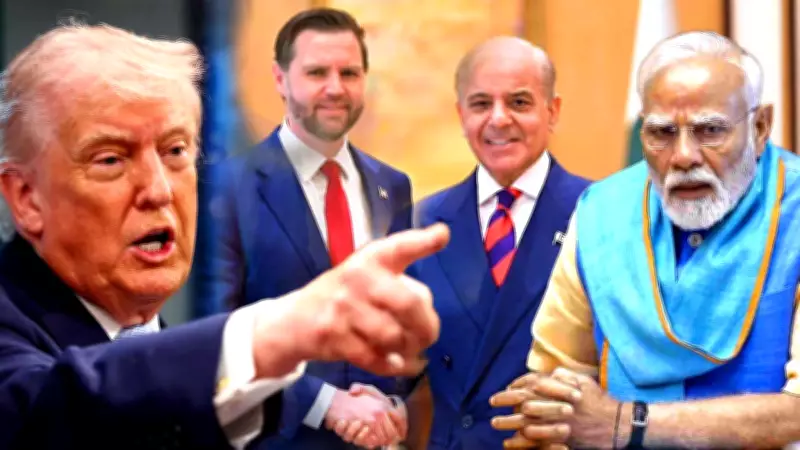
Trump's Iran Deal Hits Dead End, Shifts Focus to Pakistan Praise and India-Pakistan War Claim
In a significant diplomatic development, former US President Donald Trump's efforts to revive a deal with Iran have reportedly reached a dead end, prompting a notable shift in his foreign policy rhetoric. During a recent public address, Trump turned his attention to South Asia, lavishing praise on Pakistan's leadership while revisiting a controversial claim about his role in preventing a conflict between India and Pakistan.
Praise for Pakistani Leadership Amid Stalled Iran Negotiations
On Sunday, Trump publicly commended Pakistan Prime Minister Shehbaz Sharif and Army Chief Field Marshal Asim Munir, highlighting what he described as their cooperative stance in regional affairs. This praise comes as Trump's administration faces challenges in advancing negotiations with Iran, with sources indicating the proposed deal has effectively stalled due to unresolved issues and diplomatic hurdles.
The shift in focus from Middle Eastern diplomacy to South Asian relations underscores the evolving priorities in Trump's foreign policy approach. Analysts suggest this move may represent a strategic pivot toward strengthening alliances in Asia as other diplomatic initiatives face obstacles.

Reiteration of Controversial India-Pakistan Conflict Claim
During his remarks, Trump reiterated his previous assertion that he played a crucial role in preventing a military conflict between India and Pakistan last year. He claimed his personal intervention was instrumental in de-escalating tensions and stopping what could have developed into a full-scale war between the nuclear-armed neighbors.
"My timely involvement was absolutely critical in halting further escalation," Trump stated, emphasizing what he characterized as a decisive moment in regional diplomacy. "Without my direct engagement, the situation could have spiraled into something much more dangerous for both countries and the entire region."
India's Firm Rejection of Trump's Narrative
The Indian government has responded with a firm and unequivocal rejection of Trump's claims. New Delhi has consistently maintained that any suggestion of US mediation in halting India-Pakistan tensions is completely baseless and inaccurate.
Official statements from India's Ministry of External Affairs have emphasized:
- India's sovereign right to manage its bilateral relations without external interference
- The absence of any third-party mediation in recent India-Pakistan diplomatic engagements
- New Delhi's capability to handle regional security matters independently
Indian officials have characterized Trump's remarks as part of a misleading narrative that doesn't reflect the actual dynamics of India-Pakistan relations or India's diplomatic autonomy.
Regional Security Dynamics and Differing Narratives
The conflicting statements from Washington and New Delhi have sparked renewed political discussion about regional security dynamics in South Asia. The divergent narratives highlight:
- Differing perspectives on US involvement in South Asian diplomacy
- Contrasting views on conflict prevention mechanisms in the region
- Varying interpretations of recent diplomatic history between India and Pakistan
Security analysts note that these developments occur against a backdrop of evolving geopolitical alignments in Asia, with multiple powers seeking to influence regional stability and diplomatic relationships.
The public disagreement between Trump's claims and India's official position underscores the complex nature of international diplomacy in South Asia, where historical tensions, national sovereignty concerns, and great power interests frequently intersect. As diplomatic channels continue to operate behind the scenes, the public divergence in narratives suggests ongoing challenges in achieving consensus on regional security approaches.






