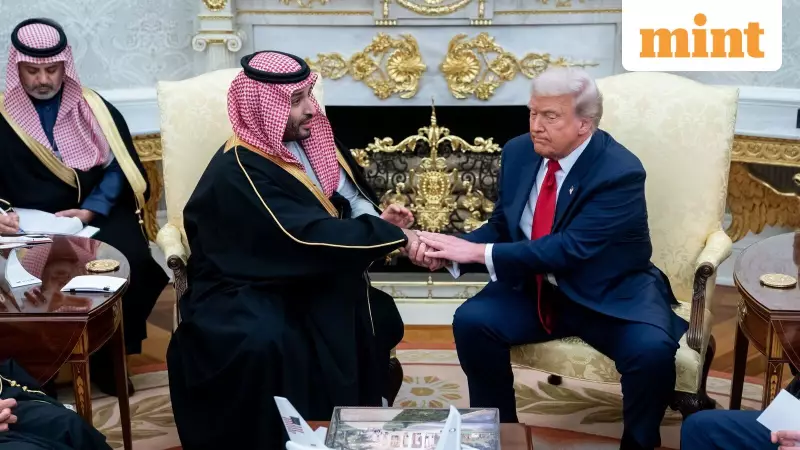
In a display of strengthened bilateral ties, US President Donald Trump warmly received Saudi Arabia's Crown Prince Mohammed bin Salman at the White House on Tuesday. The high-profile meeting was marked by significant military agreements, including the sale of advanced F-35 fighter jets, and a monumental pledge for increased Saudi investment in the United States, even as questions on human rights were set aside.
Major Deals and Strategic Partnerships
The centrepiece of the discussions was the enhancement of military and economic cooperation. President Trump officially confirmed the sale of F-35 fighter jets to Saudi Arabia, assuring that Israel's qualitative military edge in the Middle East would be protected. He stated that both nations, Israel and Saudi Arabia, should have access to top-tier military equipment.
Further solidifying the defence partnership, Trump designated Saudi Arabia as a Major Non-NATO Ally. This status grants Riyadh priority access to military purchases and enables deeper security cooperation. The two nations also signed an agreement for Saudi Arabia to purchase nearly 300 tanks from the US and are moving forward with a civilian nuclear deal.

On the economic front, the talks yielded a massive commitment. The Crown Prince agreed to raise Saudi investment in the United States from $600 billion to a staggering $1 trillion. The leaders also announced a new agreement in the field of artificial intelligence, following negotiations over advanced chips.
The Abraham Accords and the Khashoggi Shadow
The path to normalising relations between Saudi Arabia and Israel was a key topic. Crown Prince Mohammed expressed his desire to join the Abraham Accords but laid out a clear condition. He stated that Riyadh would only sign on if there is a credible, guaranteed path toward a Palestinian state.
The meeting was also the prince's first White House visit since the 2018 killing of journalist Jamal Khashoggi. When questioned, President Trump downplayed the issue, describing Khashoggi as an "extremely controversial" figure and absolving the Crown Prince of direct knowledge, saying, "he knew nothing about it".
For his part, Prince Mohammed, who has consistently denied involvement, called the event a "huge mistake" and affirmed that Saudi authorities had taken steps to ensure such an incident does not recur.
Key Takeaways and Regional Implications
The summit resulted in several critical outcomes that will shape US-Saudi relations and Middle East dynamics. The strengthening of military ties through the F-35 sale and the non-NATO ally status signals a deep strategic alignment. The Crown Prince also made headlines by claiming that Osama bin Laden's objective behind the 9/11 attacks was to sabotage US-Saudi relations.
This visit, laden with pageantry and substantial agreements, marks a significant diplomatic victory for Crown Prince Mohammed bin Salman, effectively resetting the relationship on the world stage and focusing on future economic and security cooperation.