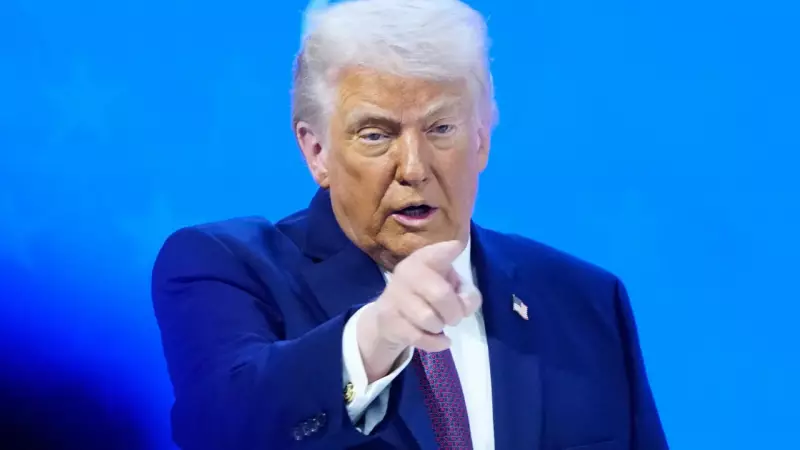
In a significant diplomatic development, US President Donald Trump on Thursday hinted at the possibility of engaging in talks with Iran, just days after issuing warnings about potential military action against the Middle Eastern nation. The remarks came during his address at the World Economic Forum in Davos, Switzerland, where he also unveiled a new initiative termed the Gaza "board of peace."
Trump's Dual Approach: Dialogue and Deterrence
"Iran does wanna talk and we will talk," President Trump declared, signaling a potential shift towards diplomatic engagement. This statement marks a notable contrast to his earlier threats of military strikes, which were made in response to Iran's violent crackdown on widespread street protests that have rocked the country in recent weeks.
The protests, which began in late December, represented one of the most significant challenges to Iran's clerical leadership under Supreme Leader Ayatollah Ali Khamenei in years. Activists report that the government's suppression has resulted in thousands of casualties, though the unrest has largely subsided following the severe crackdown.

From Military Threats to Diplomatic Overtures
Trump's push for peace comes after he explicitly threatened military action against Iran earlier this month. The President had cited Iran's violent response to protests as justification for potential strikes, including mentions of targeting Iran's nuclear facilities—a move he claimed played a crucial role in facilitating the Israel-Hamas ceasefire last June.
For now, President Trump has indicated he will not launch any new military strikes against Iran. This decision appears to be based on assurances that the Iranian government has halted planned executions of more than 800 protesters who participated in the recent demonstrations.
Iran's Response: Warnings and Readiness
Even as Trump extended an olive branch from Davos, Iranian military leaders issued stern warnings. The commander of Iran's Revolutionary Guards, General Mohammad Pakpour, cautioned both Israel and the United States against "miscalculations" in the wake of recent events.
"The Islamic Revolutionary Guard Corps and dear Iran have their finger on the trigger, more prepared than ever, ready to carry out the orders and measures of the supreme commander-in-chief—a leader dearer than their own lives," Pakpour stated, directly referring to Supreme Leader Khamenei.
Historical Context and Regional Dynamics
The Revolutionary Guards commander specifically referenced the 12-day conflict in June, during which Washington supported and joined Israel's military actions. Pakpour urged both nations "to avoid any miscalculations by learning from historical experiences and what they learned in the 12-day imposed war, so as not to face a more painful and regrettable fate."
Trump's remarks also touched upon Iran's regional influence, particularly its support for Hamas. The President noted that Iran has long served as Hamas's key backer, providing substantial military aid, weapons, training, and financial support estimated at hundreds of millions of dollars.
The Gaza Peace Initiative
While addressing Iran tensions, President Trump simultaneously introduced what he termed the Gaza "board of peace." Though details remain limited, this initiative appears to represent a new diplomatic effort aimed at addressing longstanding conflicts in the region, potentially creating a framework for broader Middle East stability.
The timing of these dual announcements—both the suggestion of Iran talks and the Gaza peace board—suggests a coordinated approach to regional diplomacy, even as military tensions remain palpable.
Strategic Implications and Future Prospects
President Trump has repeatedly left open the possibility of new military action against Iran throughout his administration. His latest statements create a complex diplomatic landscape where threats of force coexist with offers of dialogue, reflecting the administration's characteristic blend of pressure and negotiation.

As regional dynamics continue to evolve, the international community watches closely to see whether Trump's hinted-at talks materialize into substantive diplomacy or remain rhetorical gestures amid ongoing tensions. The response from Iranian leadership, particularly following the Revolutionary Guards' warnings, will likely determine the next phase of this delicate geopolitical dance.