

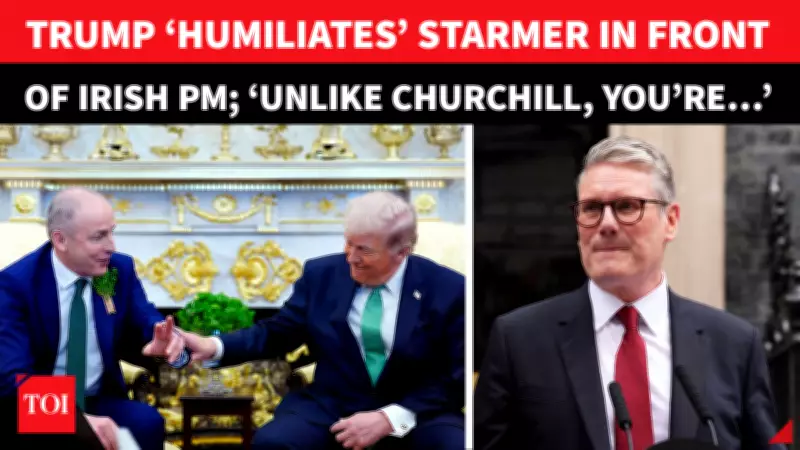
Trump Publicly Criticizes UK's Starmer Over Iran War Position
In a dramatic and contentious press conference held after a bilateral meeting with the Irish Prime Minister, President Donald Trump unleashed a fierce verbal assault on UK Prime Minister Sir Keir Starmer. The incident, which has ignited a significant diplomatic controversy, centered on Trump's disapproval of Starmer's handling of the Iran war situation.
Blistering Accusations and Historical Comparisons
Trump did not hold back in his criticism, directly accusing Starmer of damaging the long-standing "special relationship" between the United Kingdom and the United States. He stated emphatically that the UK was America's "best ally until him," implying that Starmer's leadership has led to a deterioration in bilateral ties. In a particularly pointed remark, Trump ridiculed Starmer by saying he is "not Winston Churchill," drawing an unfavorable comparison to the iconic British wartime leader known for his strong alliances with the U.S.
Focus on Iran War Stance and Diplomatic Fallout
The core of Trump's ire was Starmer's stance on the Iran war, which Trump labeled as a "big mistake." He warned that this position is weakening UK-U.S. relations at a critical juncture, as tensions in the Middle East continue to escalate. This public rebuke, delivered in the presence of the Irish Prime Minister, has sparked a firestorm in diplomatic circles, raising concerns about the stability of transatlantic cooperation during global conflicts.

The press conference highlighted growing fissures in international alliances, with Trump's comments underscoring the high stakes involved in foreign policy decisions. Observers note that such public disagreements between key allies could complicate efforts to address security challenges in regions like the Middle East.
Broader Context of Escalating Global Tensions
This incident occurs against a backdrop of heightened global instability, as evidenced by recent events such as missile strikes and diplomatic maneuvers involving various nations. While Trump's focus was on Starmer and Iran, the broader implications suggest a volatile international landscape where alliances are being tested. The public nature of this criticism may prompt reassessments of diplomatic strategies and coalition-building in the face of ongoing conflicts.
As the situation develops, the fallout from Trump's remarks is likely to influence not only UK-U.S. relations but also the dynamics of international diplomacy concerning the Middle East and beyond.






