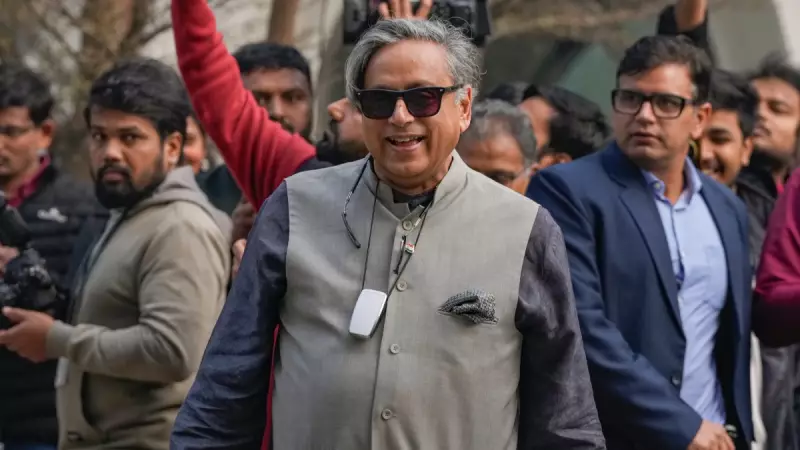
Senior Congress leader and Member of Parliament Shashi Tharoor has launched a scathing critique of the recent United States military strikes inside Venezuela. The former diplomat and author characterised the action as emblematic of a disturbing new global creed where 'might is right' supersedes international law and sovereignty.
Tharoor's Sharp Condemnation of US Action
In a pointed statement, Shashi Tharoor expressed his strong disapproval of the US decision to conduct military operations on Venezuelan soil. He framed the event not as an isolated incident, but as a symptom of a broader and more alarming trend in international relations. For Tharoor, this action represents the brazen application of raw power, where stronger nations feel entitled to violate the borders of weaker states based solely on their own strategic or political interests.
The Thiruvananthapuram MP underscored that such operations fundamentally undermine the principles of national sovereignty and the established norms of the United Nations Charter. He argued that when a powerful country like the United States takes such unilateral military steps, it sets a dangerous precedent for the entire world order. The act, according to his analysis, moves global politics away from diplomacy and rule-based engagement and towards a more primitive and volatile system governed by force.

The 'Might is Right' Doctrine in Modern Geopolitics
Central to Tharoor's criticism is the revival of what he terms the 'might is right' creed. This phrase, loaded with historical context, suggests a return to an era where legal and ethical considerations are discarded in favour of sheer military or economic strength. Tharoor implies that the US strikes in Venezuela are a clear manifestation of this doctrine, where justification follows action, rather than precedes it.
His comments reflect a deep concern about the erosion of multilateralism. The ideal of nations resolving disputes through dialogue and within international frameworks appears to be weakening. Instead, powerful states are increasingly resorting to coercive measures, including military intervention, to impose their will. This creates a highly unstable global environment, especially for smaller and developing nations that lack the capacity to deter such actions.
Tharoor's perspective is particularly significant given his extensive experience in international diplomacy as a former Under-Secretary-General of the United Nations. His critique carries the weight of someone deeply familiar with the intended workings of the global system, witnessing its breakdown.
Implications and the Road Ahead
The consequences of this 'might is right' approach, as highlighted by Tharoor, are far-reaching. It can lead to:
- Increased Global Instability: Other regional powers may feel emboldened to conduct similar cross-border strikes, citing the US precedent.
- Erosion of International Law: The foundational principles of sovereignty and non-aggression become negotiable, weakening institutions like the UN.
- Heightened Tensions: Such actions inevitably provoke strong responses from the targeted nations and their allies, potentially spiraling into larger conflicts.
For India, a nation that has consistently championed the principles of sovereignty and peaceful resolution of disputes, this development is particularly disquieting. Tharoor's statement indirectly calls for a reaffirmation of these core principles. It urges the global community, including India, to advocate forcefully for a return to diplomatic channels and to condemn actions that violate territorial integrity, regardless of who undertakes them.
In conclusion, Shashi Tharoor's condemnation of the US strikes in Venezuela goes beyond the specific event. It serves as a stark warning about the direction of contemporary geopolitics. By labelling it the new 'might is right' creed, he challenges the international community to reflect on whether this is the future it seeks—a future where power trumps law, and strength dictates justice. The call is for vigilance and a renewed commitment to the rules-based order that has, however imperfectly, maintained global peace for decades.