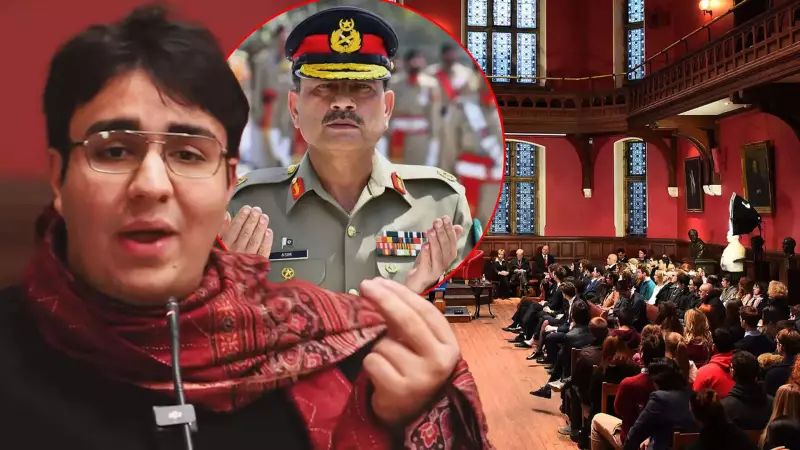
A recent debate at the prestigious Oxford Union has sparked a fresh global conversation on nuclear strategy in South Asia, following a powerful intervention by student speaker Siddhant Nagrath. His arguments, which have since gone viral, directly challenged the long-held notion that Pakistan's nuclear arsenal acts as a stabilising force in the region.
Dismantling the Myth of Nuclear Restraint
During the debate, Nagrath presented a compelling counter-narrative to the idea of nuclear restraint. He asserted that nuclear weapons are not restraining Pakistan but are instead enabling aggressive behaviour that would be unthinkable without them. This core thesis struck at the heart of conventional nuclear deterrence theory as applied to the India-Pakistan context.
Nagrath elaborated that the possession of atomic arms provides a shield behind which certain actions can be pursued. He suggested that this dynamic fundamentally alters the strategic calculus, making conflict more probable under specific conditions rather than less. His speech, delivered on December 23, 2025, has forced a re-examination of established geopolitical assumptions.

Conflict as a Tool for Power Consolidation
The student debater delved into the domestic political mechanics within Pakistan that are fueled by hostility with India. He made a sharp observation about who truly benefits from bilateral tensions. "When India and Pakistan clash, it is not Narendra Modi whose position improves the most," Nagrath argued. Instead, he pointed the spotlight towards "the people who hold power, money and guns in Pakistan."
This analysis frames conflict as an instrument for internal power consolidation. Nagrath posited that for Pakistan's entrenched elite, sustained peace with India is both politically and economically unviable. Confrontation, therefore, serves to strengthen the position of key power brokers, including the military establishment, rather than Indian political leadership.
Terrorism as State Policy and Global Implications
In one of his most pointed critiques, Nagrath addressed the issue of cross-border terrorism. He described it not as a rogue element or an aberration but as an instrument of state policy. This characterization aligns with longstanding Indian diplomatic positions and accuses the Pakistani state structure of institutionalising asymmetric warfare as a strategic tool.
The viral spread of this debate has reignited a complex global discussion. Experts and analysts are once again pondering a critical question: does nuclear deterrence in South Asia genuinely prevent war, or does it simply create a permissive environment for lower-intensity conflicts and proxy warfare? Nagrath's speech strongly advocates for the latter view, suggesting that the nuclear umbrella has made the region more volatile, not more secure.
The Oxford Union debate highlights a growing intellectual challenge to traditional nuclear doctrine. By framing weapons as "tools for escalation, not peace," Nagrath's arguments provide a stark reminder of the unique and dangerous dynamics that define the India-Pakistan relationship, where existential threats and domestic power games are inextricably linked.